
For a wine lover Bordeaux is an obvious choice of destination when visiting France. Bordeaux has 36 different appellations of wine, so it isn’t quite as simple as just deciding to visit the city of Bordeaux, you need to decide which appellation (or wine growing region) to visit.
If you are looking for the best wines in Bordeaux, then you may have come across the Official Classification of 1855, still used to this day to distinguish the best Bordeaux wine. The classification was made for the 1855 Universal Exhibition in Paris. The president of the chamber of commerce wanted to put together a list of the best Bordeaux red wines. He called upon the wine merchants of the city and together they produced a list of 57 of the very best Chateaux (classed as Grands Crus). The interesting part about this list is that it was not based on a tasting. The wines were classed on their reputation and trading price.
All but one of the domains in the original 1855 red wine classification come from the Medoc region. Pauillac takes up a large number of positions on the list, including two of the four Premier Crus (the top classification), but at over an hours drive from the centre of Bordeaux it isn’t necessarily the best choice for visitors. Margaux has significant number of classed properties, including Chateau Margaux which is one of the four premier cru, and is only a 40 minute drive. (see note at the end about access).
The Medoc tourism office produce a guide to the vineyards (vignobles) of the area. There are 20 chateaux listed for Margaux, including 9 with the grand cru classification. Notably missing is the Chateau Margaux itself.
Chateau Margaux: Can You Visit?
Not only is Chateau Margaux the most prestigious of the Grand Crus estates in the appellation of Margaux, it is also the most productive, with around 300 000 bottles produced each year.
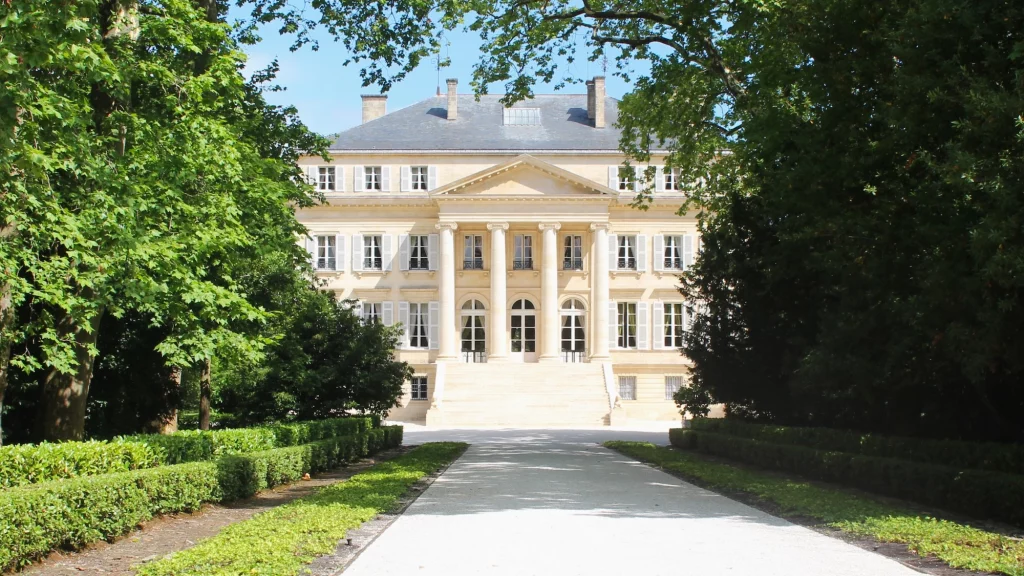
The Chateau itself dates from 1815, but there was a house and vineyard here long before that. The property has changed hands a number of times over the years, both before and after the 1855 classification. The current owner, Corinne Mentzelopoulos, daughter of a Greek Businessman, inherited the property on the death of her father in 1980. Three quarters of the property ended up in the hands of the Agnelli family (founders of Fiat) but Corinne Mentzelopoulos bought back the property in 2003.
The stunning house isn’t open to the public, and the vineyard is only open to a very few favoured wine professionals and customers. I was fortunate enough to be invited along to accompany one of the visits.
Alongside the old buildings and cellars on the property is the new vat room designed by celebrated architect Norman Foster opened in 2015. This was the first major modernisation of the property since its construction and has provided extra space for new, stainless steel, fermentation tanks which enables the winemaker to keep the grapes from each plot totally separate until it is time for blending. These tanks add to the existing wooden vats, some of them over 60 years old. The wine spends around 3 weeks in these tanks before being put into barrels for ageing. These barrels are kept in huge barrel cellars (chai à barrique). At Chateau Margaux there are two areas, one above ground used for the first ageing, and one below ground for the second.
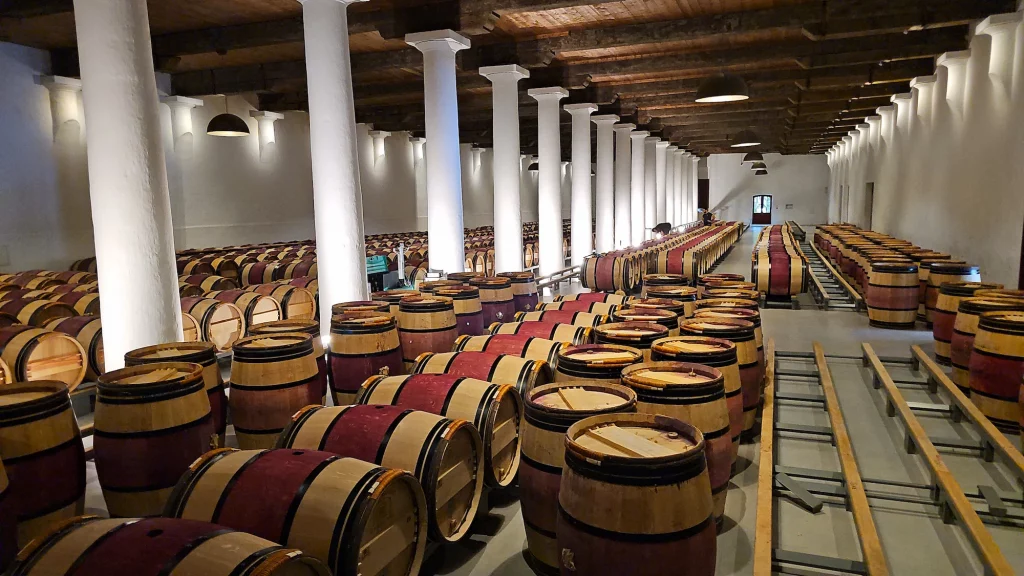
Margaux wine is made of a blend of Cabernet Sauvignon, Merlot and Petit Verdot. Chateau Margaux make this blending after 6-8 months in oak barrels. Up to this point each variety and plot are kept separate. Once blended the wine is returned to the barrels which are then stored in the underground chai for another 12-14 months before being bottled.
The sight of hundreds of barrels of Chateau Margaux laid out before you is certainly an impressive one, especially if one stops to think about the investments that it represents. There is clearly a respect for product in the way you can see the barrels being handled, and a floor cleaner was going around to make sure the chai was kept in immaculate condition.
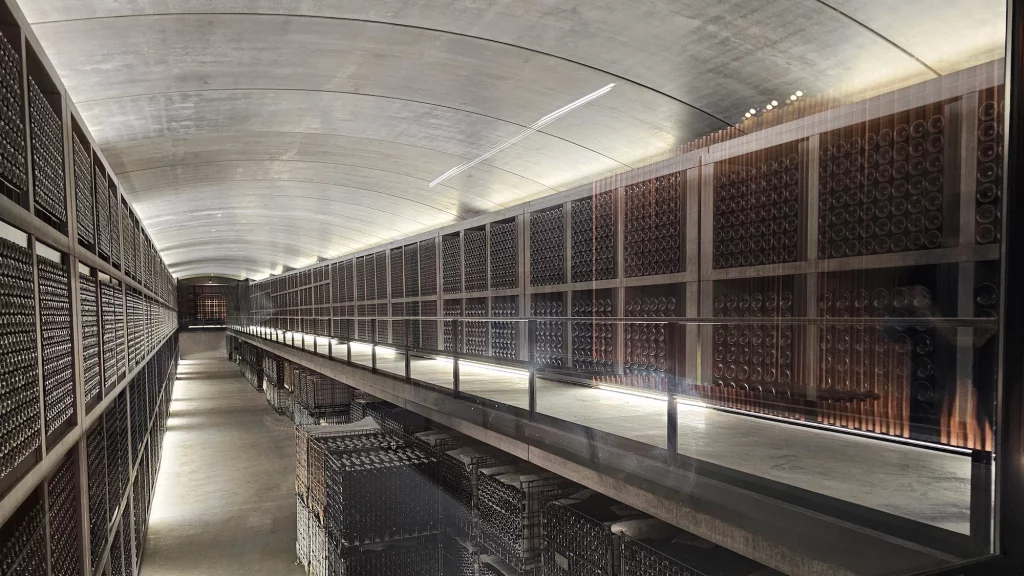
Tastings take place in an underground room with a glass frontage out to the underground wine library, also designed by Norman Foster. Here there are stocks of wine going back decades, and not just normal sized bottles, but magnums and Jéroboams. Given the expense of building a dedicated space to store these bottles it is clearly important to the establishment. Though it was not clear to me what the long term aim of the storage was. Perhaps a way of storing money for the future generations, or perhaps merely an archive of what has been produced here.
It certainly made for an interesting back drop for our tasting. We got to taste a 2011 Chateau Margaux, and a 2015 Pavillon Rouge, which is the name given to the second wine produced here.
In order to keep the high quality of the wine from the major chateaux, a second wine is produced from the wine that doesn’t make the grade for the main wine. There is no fixed amount of each wine made, it depends on the harvest and the quality of the wine but in general Chateau Margaux put about 33% of the harvest into Chateau Margaux and 30% into the Pavillon rouge.
It is said that the Pavillon doesn’t have quite the same complexity and magic of the Chateau Margaux, and that it can be drunk slightly younger. For my part I found them both to be excellent wines, and have a slight preference for the Pavillon.
To give an order of magnitude of price the Chateau Margaux 2025 can be ordered retail for around 470€ a bottle whereas the Pavillon is 134€ a bottle (both for delivery in 2028 – this is wine that is still in the barrels underground).
Overall it was an enjoyable visit, and a privilege to be shown around such a renowned and historic establishment. But I wondered if visitors were really missing out by not being able to visit, and whether a visit to one of the other Grand cru Chateau would be just as valuable an experience.
Chateau Kirwan
If you thought Kirwan doesn’t sound like a very French name, you would be right. An Irishman, Mark Kirwan, set himself up as a wine merchant in Bordeaux in the middle of the 18th century. He bought a vineyard, Domaine de Lassalle, and named it after himself. As it was under this name that the 1855 classification was given the name has stuck, despite several changes of ownership since. These include a period when the city of Bordeaux owned the property after being left it in the will of Camille Godard, who had been deputy mayor of the town.
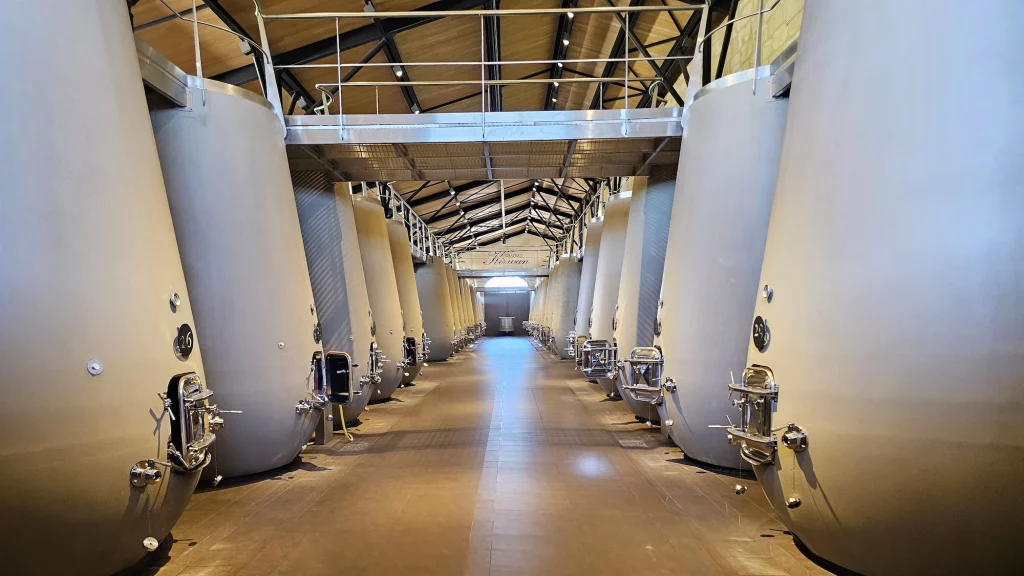
The chateau is a private residence and not open for visits, but the rest of the domain welcomes and is well set up for visitors. A standard visit at Chateau Kirwan takes you to visit the vines, before entering the vat room and barrel cellar. Recent renovations have taken place here too, with a modern new building straddling the two historic cellars. One notable difference here is that the vats at Chateau Kirwan are all new concrete vats, favoured by the winemakers for their oxygenating properties.
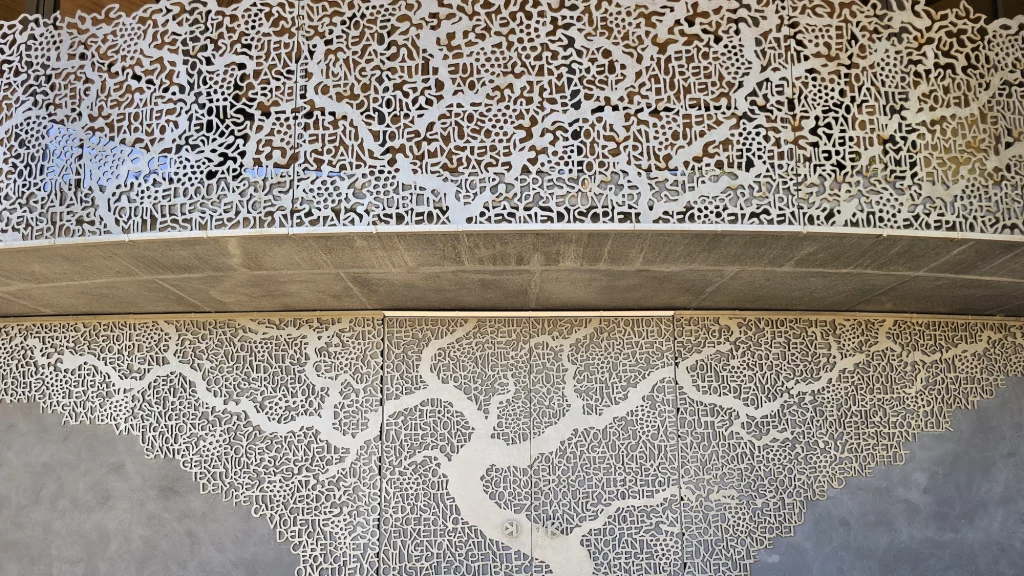
The owners are art lovers and there are pieces of art dotted around the building. The front of the new building is a piece of art in itself, a metal cutout in the shape of a grapevine, with words and names relevant to the wine woven into the structure. It is quite beautiful.
Tasting here took place in the boutique, with a 2018 Chateau Kirwan and a 2018 Charmes de Kirwan (the second wine in this domain) both elegant wines with a soft velvety texture. The Charmes de Kirwan is slightly more vibrant and fresher and again was my favourite. At around 34€ for their 2025 vintage they represent a far more affordable option for a Margaux wine. A tour costs 30€ with a tasting of 2 wines.
Chateau Kirwan truly understand what a visitor might be looking for, and offer various other options including an immersive tour that goes into details about how the vines are grown and looked after, and a picnic option, where you can enjoy the wine accompanied by a locally prepared picnic eaten in the beautiful grounds.
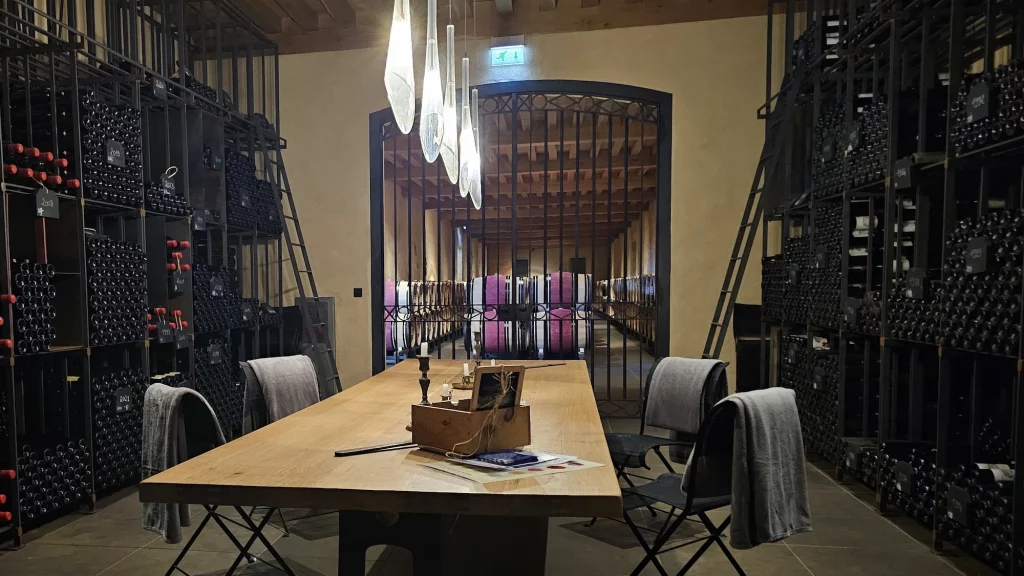
Chateau Kirwan have a stock of vintage wines too, and you can arrange a tasting in the special vintage room. You even get to choose the vintage to represent a special date, which is such a great way to mark a special birthday or anniversary.
Chateau Marquis de Terme
This is another Chateau named in the 1855 classification, and another chateau that has undergone significant recent renovations to its buildings.
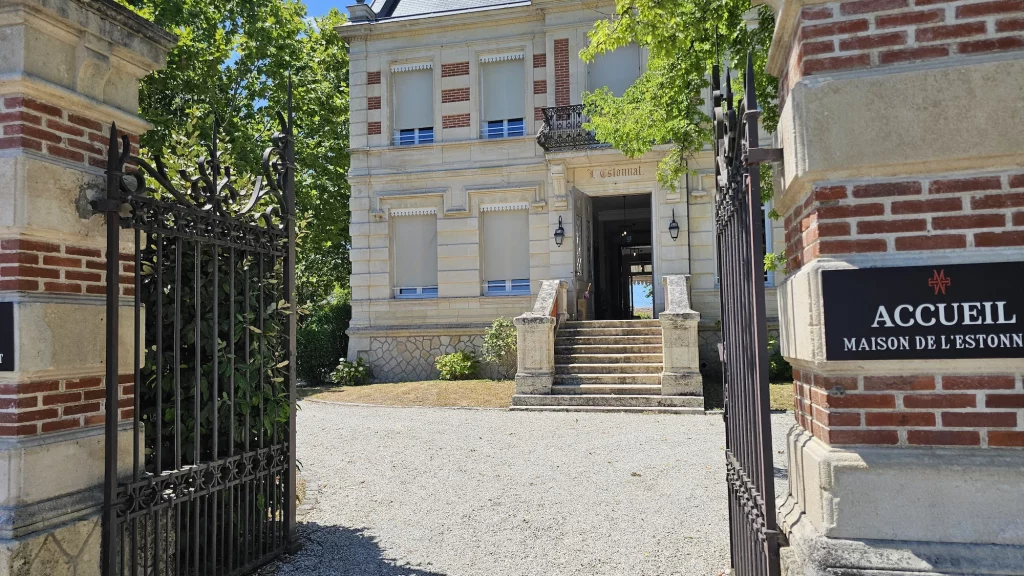
The visit at Chateau Marquis de Terme starts in the neighbouring villa before passing through the park, past the beehives, and into the working part of the vineyard.
Tastings take place either under the shade of a tree in the park or in the boutique, where you can also find other wine related souvenirs. By way of comparison the 2023 vintage is available for 45€.
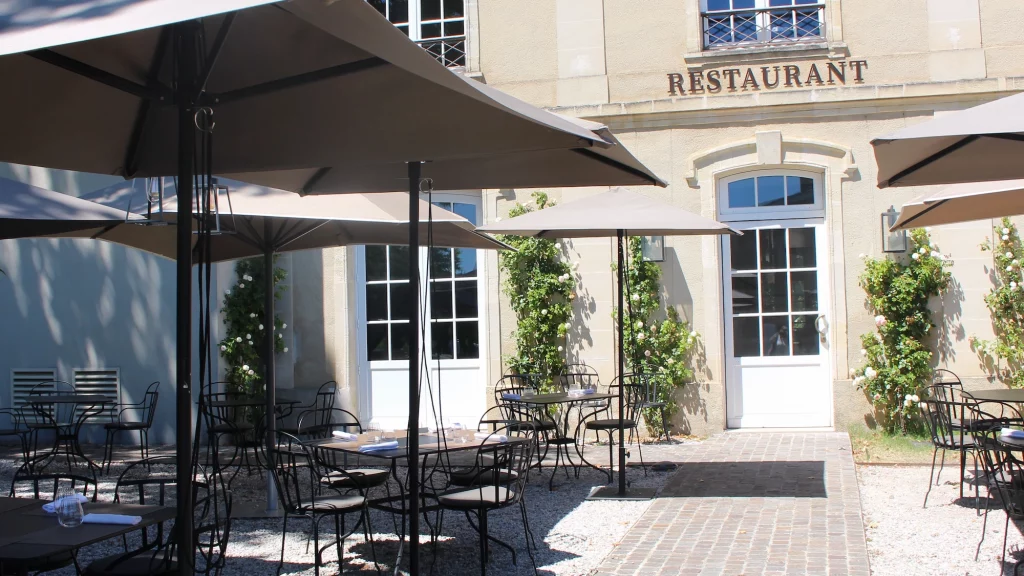
The Chateau Marquis de Terme know how to welcome people. They won the best welcome at a vineyard award in 2023 from La Revue du vin de France. The interest for visitors here doesn’t stop at the vineyard. They have an onsite restaurant run by the acclaimed French restaurateur Grégory Coutanceau. There is a shortage of good restaurants in the immediate area so this is an address visitors will want to note. The setting is seductive, with views over the vines from one side and a terrace within the park of the vineyard. The Menu du Marché is an extremely reasonable 33€ for 3 courses and of course they have menus which match up with the Grand Cru Classé wines from Chateau Marquis de Terme.
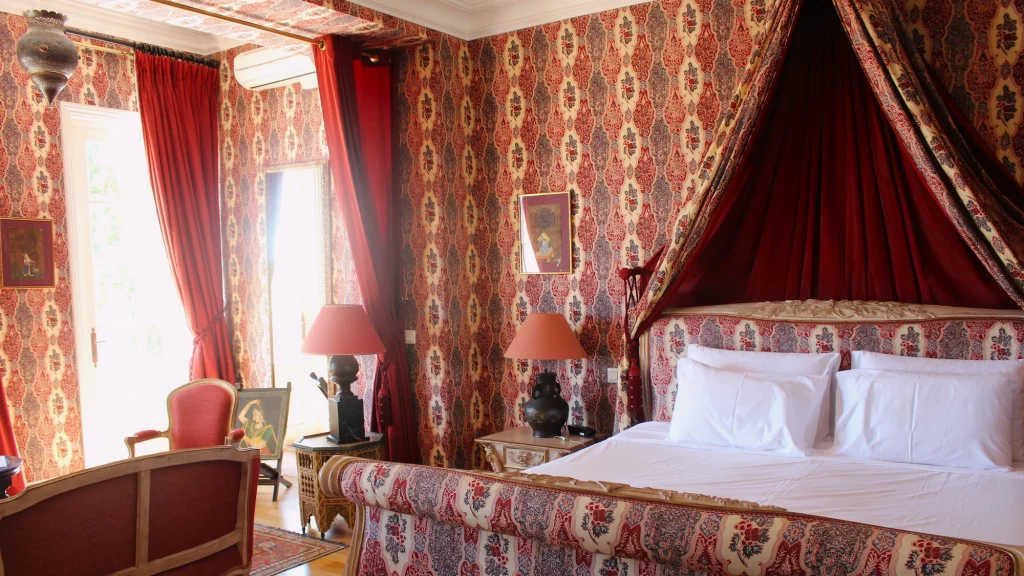
The chateau are also branching out into accommodation, with 5 beautifully decorated bedrooms inside one of the Chateau buildings, which will shortly be linked to the vineyard with a lit path. At the moment breakfast is served in the nearby hotel, but more renovations will eventually bring everything on to one site, making it a very special place to stay.
Chateau Marquis d’Alesme – La Parenthése Enchantée (The Magical Interlude)
The Chateau Marquis d’Alesme (listed in the 1855 classification under the name Becker) offers a wine tasting experience like no other. Another large renovation project took place here, with a very different outcome.
The owner Nathalie Perrodo (of the Perrodo family) inherited the property on the untimely death of her father and launched a mammoth building project to improve the chateau. Together with architect Fabien Pédelaborde the domain has been transformed into an enchanted world where east meets west. Nathalie’s mother is from Hong-Kong and the architect wove this dual cultural heritage into the very fabric of the project.
The result is remarkable. A working vineyard with a zen like atmosphere. Every detail has been meticulously thought out. The entry and courtyard, where anyone is welcome to enjoy a coffee or a glass of wine or eat at the restaurant “La Table de Nathalie”, gives you a taste of the quality of the property.
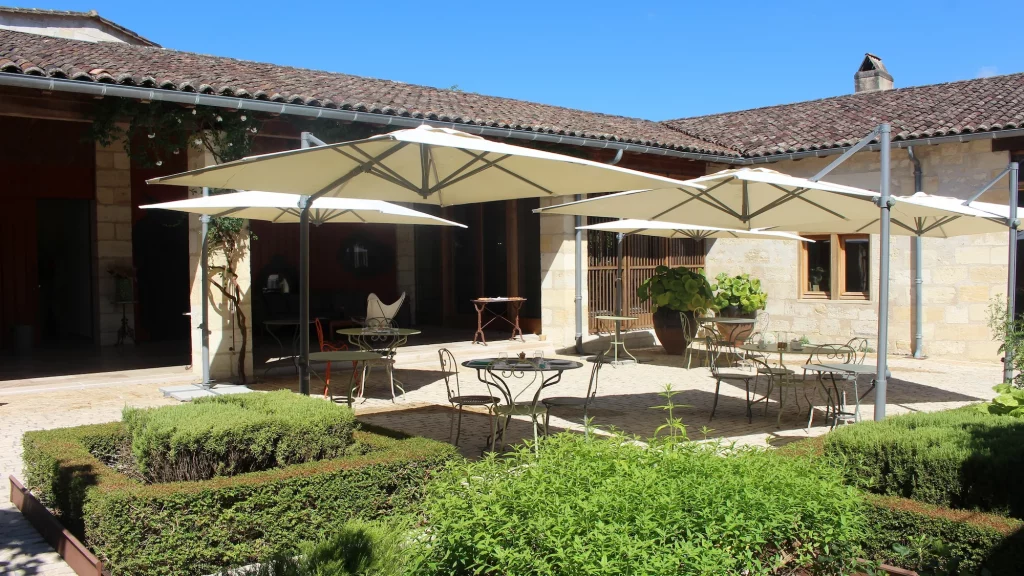
The visit and wine tasting is sold under the name La Parenthèse Enchantée or the Magical Interlude, which I find utterly charming. The tour takes you through the entrancing gardens, with jasmine archways, and white agapanthus blowing in the breeze. There are some modern art pieces dotted around, including a rather mesmerizing mirror installation reflecting the surroundings.
There is one old building in the grounds that was moved, stone by stone, from the other family run chateau in the area, as a sign of the dedication this building project had. There are details everywhere, from the gate that leads to the vat room to the dragons on the end of the downpipe.
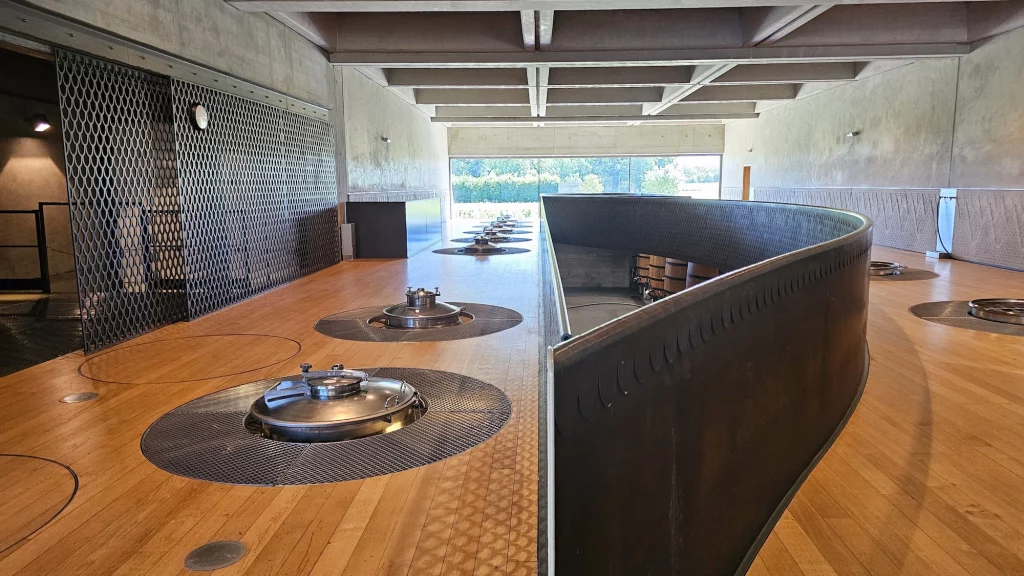
Walking into the vat room is a little like walking into a museum. The floor is a polished parquet, the top of the vats sticking up like baby UFOs. There are drop shaped barriers to the light wells looking down to the tanks below, which have been covered with bronze scales to represent the dragon that stands guard over the wine. The walls are engraved and even the ceiling has been sectioned according to feng shui principles.
It makes one wonder how this can possibly be a working vineyard and what any of it has to do with winemaking, lovely as it is. Over lunch my contact, Melissa, tells me about the first visit she did once the renovations were complete, with a group of wine makers. They dismissed the parquet flooring as impractical for a working winery and that they would be ruined by wine stains. On asking Nathalie how she should respond to such comments Nathalie replied that a beautiful environment encourages people to be careful and meticulous in their work, which in turn would give better results. Seven years on and I saw no stains on the parquet flooring, or anywhere else for that matter.
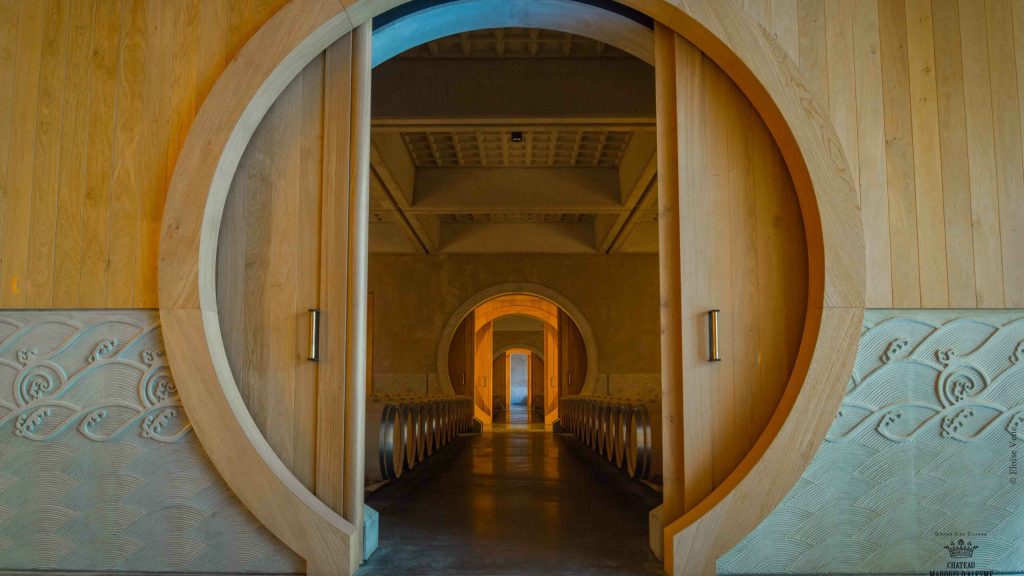
The barrel cellars are no less impressive. Huge circular wooden doors slide open to reveal the rooms where the barrels are aged. Rows and rows of perfectly aligned pristine barrels, under a dim light as though babies laying down to sleep peacefully. The ornate walls and ceiling and the quality of the workmanship would be more at home in a very high end spa than a vineyard.
Tastings normally take place in the hamlet, the group of buildings at the entrance, but I was fortunate enough to taste both the red wine and the experimental white that is being produced by the chateau, over lunch at La Table de Nathalie. Food here is fresh, following garden to table principles. Many people visiting the area eat in Bordeaux in the evenings so appreciate a light palate cleanser at lunch.
If you are travelling with children then you are well catered for, with a specially crafted treasure hunt in search of the five senses of the dragon Jingyang. Aimed at children 6-12 years old this is offered free of charge for guests’ children. I know my daughters would have loved it at that age, these days they are more likely to join me in the wine tasting.
The visits here cost 70€, including the tasting (2 vintages of the Grand Cru Classé). Given the sense of calm and well being the place imparts, not to mention the extremely high quality of the wine, it seems like good value. It should be noted that it is only open Mondays to Fridays and prior booking is essential.
Chateau Paveil de Luze
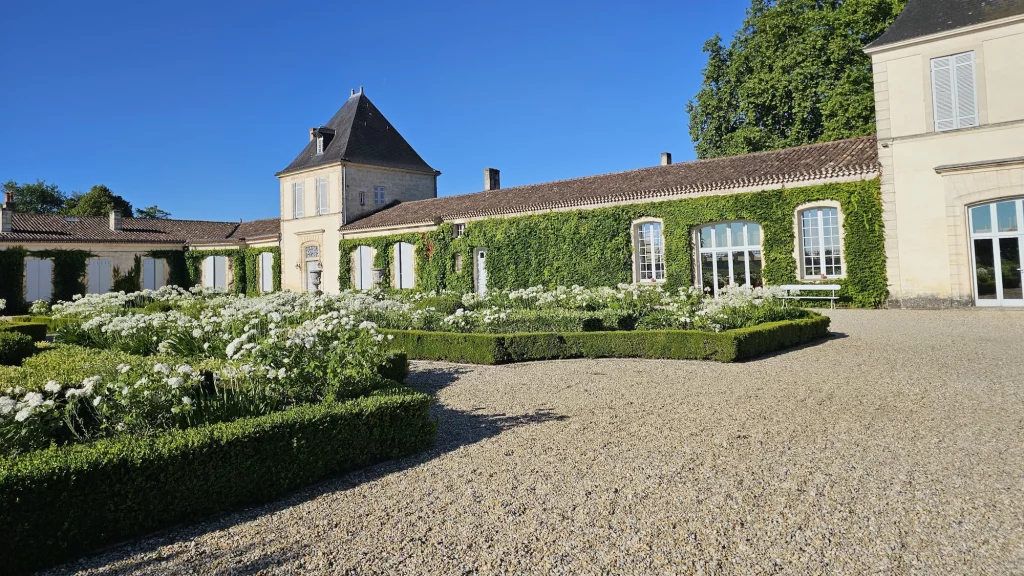
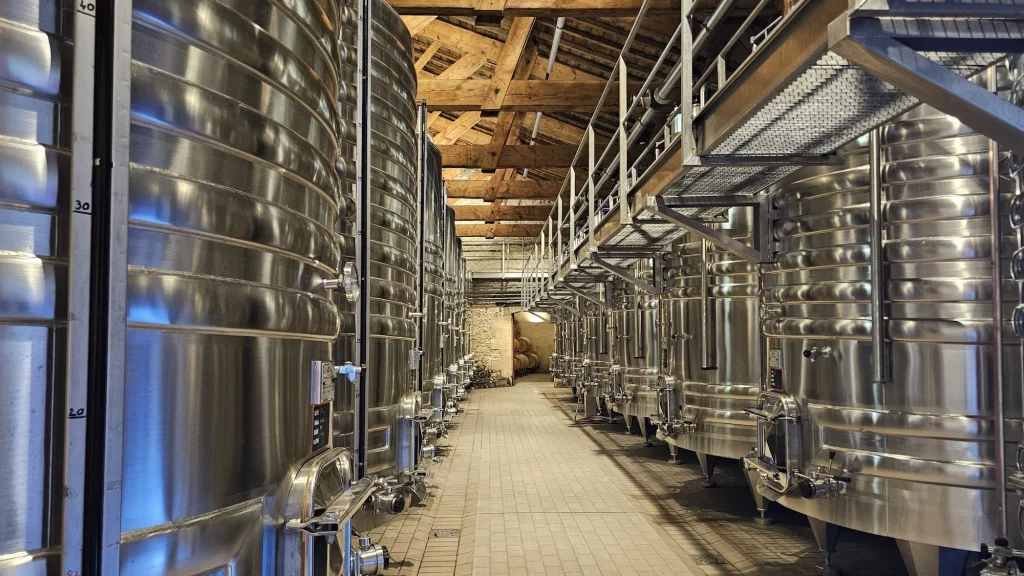
Not all the chateaux in the area figured on the 1855 list, but that doesn’t make them less interesting to visit. The Chateau Paveil de Luze is one of the oldest properties in the Margaux appellation and unlike the other chateaux on this list, has been in the same family since 1862. Much of this visit feels much more like one would expect from a traditional winemaker, until you get to the vat room with its shiny stainless steel tanks and control features.
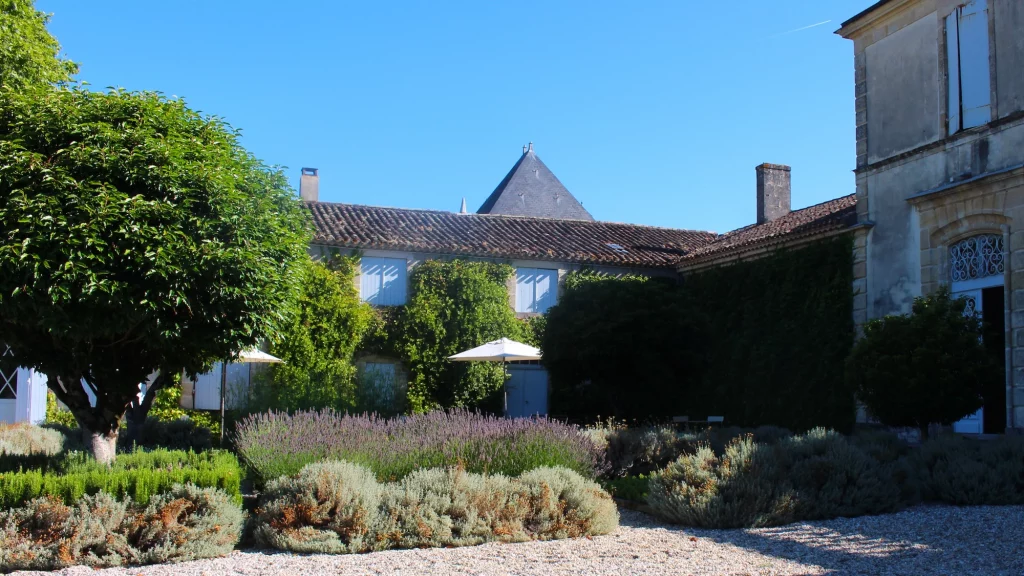
The gardens are dreamy, with lawns sloping down towards the lake. Some serious progress towards biodiversity have been made, including selective mowing, and the owner, Madame de Luze, tells me the increase in the number of butterflies and pollinators in the garden has been striking.
I tasted a 2015 Chateau Paveil de Luze which is sold under the Margaux Appellation as well as a 2018 Petit Paveil (their second wine) sold under a Bordeaux appellation. Again both were delicious, well rounded wines, and again I preferred the second wine. The second wine here can be up to 50% Merlot, and in general the second wines have a higher percentage of Merlot which may explain my preference.
Visits to Chateau Paveil de Luze cost a very reasonable 15€, which includes a tasting of 2 reds and a white. Picnics are also available which can be enjoyed in the garden. Wines start at 9,50€ for the Petit Paveil, which brings it more in line with my normal budget. The 2025 vintage is 19.50€
Is Margaux worth visiting?
Bordeaux is one of the great names in wine, and a visit to a chateau would no doubt be the highlight of any wine lovers trip to France. Margaux has the perfect combination of being near to the city centre and offering a large choice of chateaux, each different from the other, to visit. My experience is that not having access to Chateaux Margaux, does not diminish the experience at all. You can always go up to the chateau gates to see the building, but the welcome you will get at the other chateaux will more than make up for the lack of access.
I am not doubting Chateau Margaux in terms of its positioning as being one of the best wines in the world. But relying on a classification based 150 years ago on the price of wine seems to me just a little short sighted. The other wines I tasted in the area were, at least to my palate, equal to the Premier Grand Cru Classé particularly that of Chateau Marquis d’Alesme whose vineyards back onto those of Chateau Margaux.
If you do come, book 2 or three visits ahead of time, allow 2 hours between the visits and make one of the visits coincide with a picnic or lunch at one of the restaurants. While you may be able to get there by Uber or taxi, be warned that getting back into Bordeaux can be much more difficult. I advise you to hire a car, or even better hire a driver for the day. That way you won’t need to make use of the spittoon like I did.
My visit to Chateau Margaux was organised through a personal contact. I would like to thank The Margaux Medoc Tourism Office for organising the visits to the other Chateaux. If you are unsure which wine tour would suit you best then talk to the wonderful people there who will be able to guide you.
If you are planning your first trip to Europe then make sure your read How to plan a trip to Europe: the 3 essential first steps

If you need help with planning your trip then check out our services

If you have any questions about travel itineraries in Europe then drop us a line.  We are happy to help.

If you want more tips and ideas for visiting Europe then FOLLOW ME ON INSTAGRAM