
If you are visiting England for the first time and want to get a feel for real England then Derbyshire isn’t necessarily the first place that comes to mind. But it should be.
The Cotswolds may be closer to London, but in terms of scenery it doesn’t compare to the Peak district. The Peak district is beautiful and is rugged and wild in a way that the picture perfect Cotswolds could never be. Yet the Derbyshire Peak district gets a fraction of the overseas visitors that visit the Cotswolds.
Each has the draw of a large country house. For the Cotswolds it is Blenheim Palace in Oxfordshire, birth place of Winston Churchill. For the Derbyshire Peak district it is Chatsworth House, home to the Duke of Devonshire and the final resting place of Kathleen Kennedy, JF Kennedy’s sister.
Chatsworth House and Gardens in Derbyshire
Chatsworth House is also better known by some as Pemberley, having been used as Mr Darcy’s abode in the 2005 Pride and Prejudice film. It is believed that Jane Austin did indeed base Pemberley on Chatsworth House and she certainly stayed nearby in Bakewell.
Jane Austin themed events are held at the house. There was an event organised the day after my visit and these are a big draw from tourists across the world. The house sits in the Derwent valley in some of the most beautiful parkland you will find in England. The 1000-acre park was redesigned by Capability Brown for the 4th Duke of Devonshire in the 18th century, and the style is still very evident today.
As you enter the estate, across a cattle grid to prevent the flocks of sheep from roaming, you see a poetic vision of England, with softly rolling hills, and trees planted singularly or in carefully curated clusters. You can’t see the house at first, but when it comes into view you truly appreciate the beauty of the place. Even in the persistent rain it took my breath away. I have rarely had such a visceral reaction to seeing somewhere. No photograph or video can truly do it justice.
Unfortunately, there is nowhere to pull in and enjoy the view so I continued on to the car park. You can pay on arrival here, but to make sure you can get into the house at your preferred time it is preferable to book online in advance. I chose the first time slot of the day hoping that the weather would be better later (it wasn’t). One of the, very helpful, guides in the house told me that lunchtime is the quietest period.
I use the word house because that is the official title, although in any other country this would be considered a palace. It is home to a Duke. There are 300 rooms, 17 staircases and half a mile of corridors within the building. The English aristocracy don’t use the term Palace unless it is a royal residence (Blenheim Palace is an anomaly in this respect: it was gifted by the Monarch).
You can choose an audio guide at the entrance or simply wander through the rooms. There are written explanations in each room as well as a guide who is happy to talk about the room and the history. These are people who clearly love the house and are passionate and knowledgeable about the subject. This should be the way it is done in all museums. Rather than having someone in the corner watching people, get them to engage. I’m sure visitors would get far more out of their visits, and the time would no doubt pass quicker for the guardians.
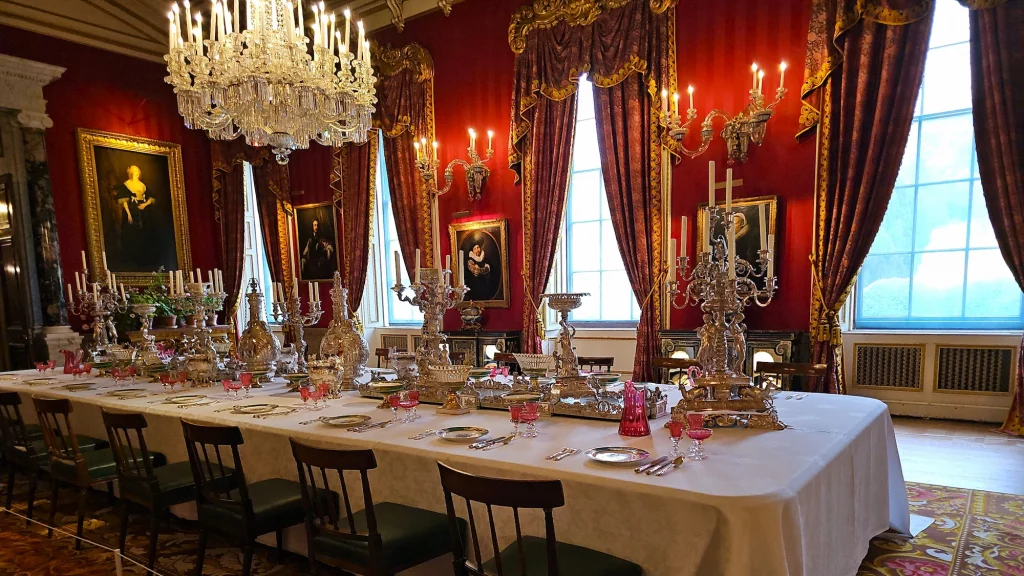
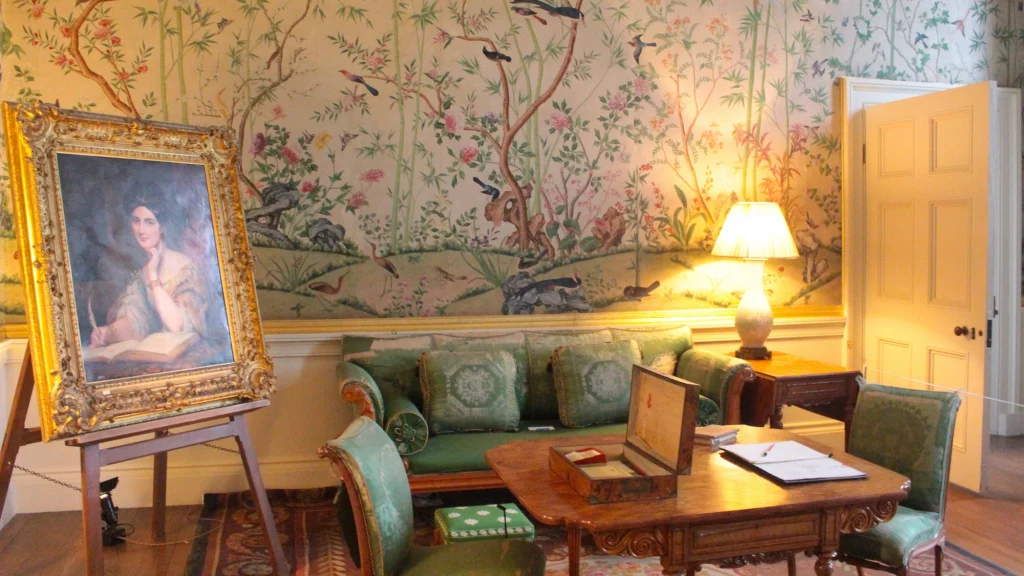
The is seemingly no time restriction for the visit, and by hanging back a little after entry I found myself almost alone in some of the rooms. The whole house is beautiful. The family seem to have been blessed with good taste through the generations. Even the very ornate rooms, which could easily become gaudy, work here. My favourite rooms are the bedrooms with hand painted Chinese wallpaper. The audio guide explains how, in one room they got the measurements wrong, so they had to paint the top of the wall and make it match with some cutouts of the wallpaper.
The sculpture room is another favourite. It looks like a national museum. The sculpture by Canova of a dog looking longingly at his master is stunning, not only in the craftsmanship, but in the way the emotion of the dog is portrayed.
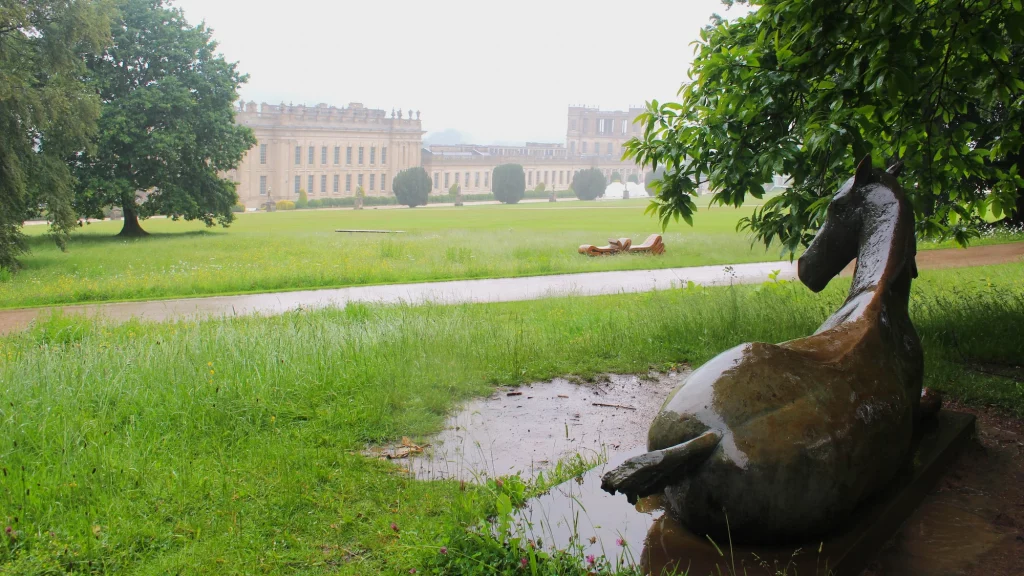
The family are clearly dog lovers and there are several statues around the house as well as paintings in the Oak room of long-lost pets. Other statues scatter throughout the grounds, not just dogs, but other animals too. I particularly like the horse laying in the shade of an old tree looking down towards the house.
In truth, as lovely as the inside of the house is, my true love at Chatsworth is the gardens. Although there are formal elements to the garden such as the topiary and the maze, it is the wilder parts that are, to me, a complete wonder. If feels like nature is putting on a show and that human hands are merely a guiding force.
Stepping off the main path and down some side paths and I found myself in a little valley, covered with gunnera. Small streams tinkle their way down to the main lake, the colourful geums lining the banks.
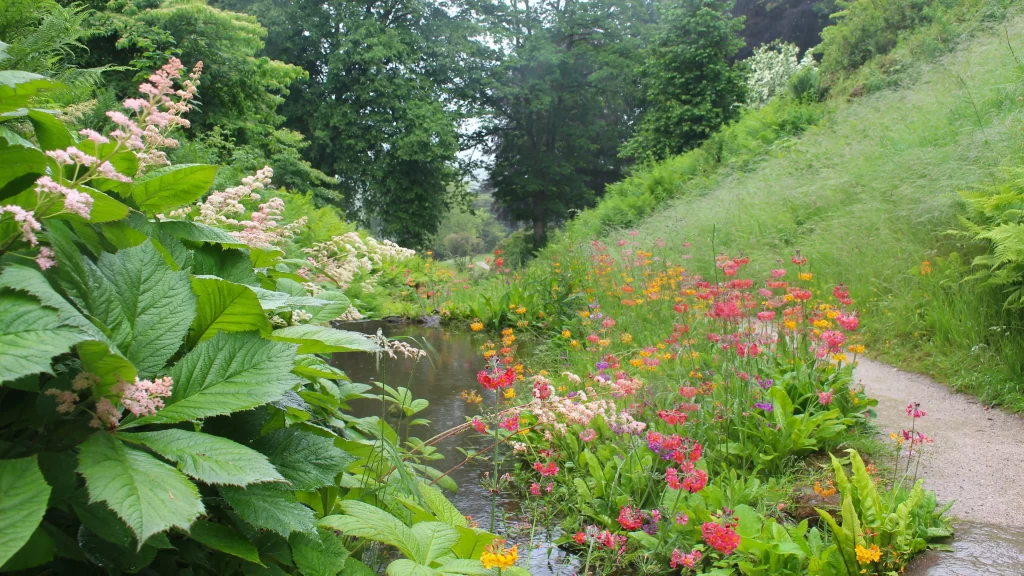
Even the constant rain couldn’t dampen the beauty of the place – and the rain had the advantage of scaring everyone else off, so I had the gardens practically to myself once I left the, very impressive, kitchen gardens. I walked for 20 minutes without seeing a single soul. Being drenched was a small price to pay.
As enchanting as they are, 2 hours walking in the rain saw me hit my limit, so I left Chatsworth and sought shelter in the Chatsworth Kitchen Café in the nearby village of Rowsley. Rowsley is a small village and the river Derwent, with some of the loveliest stone cottages, roses everywhere, and an extremely good hotel, The Peacock at Rowsley, where I was fortunate enough to be staying. (see review)
Haddon Hall in Bakewell Derbyshire
The Peacock used to be the Dowager house for the nearby Haddon Hall, which was my next stop. You may never have heard of Haddon Hall, I certainly hadn’t, but when you see it the house may seem very familiar as it is often used as a film set. From Jane Eyre to Wolf Hall, production companies have taken advantage of its un-modernised Tudor and Elizabethan interiors and striking exterior and garden.
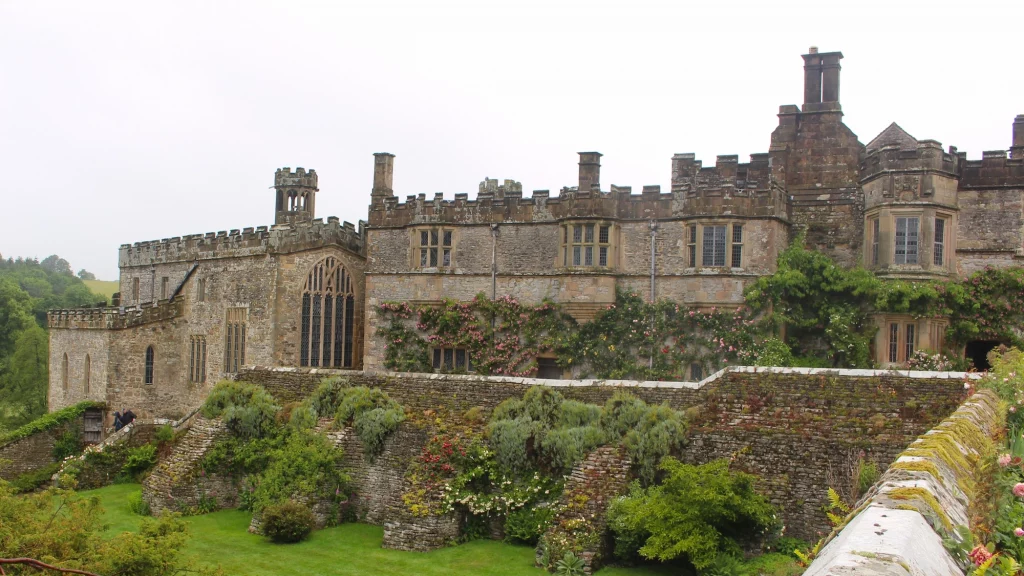
Haddon Hall sits, like a castle or fortress, on a hilly outcrop above the river, but is surprisingly not clearly visible from the road. The main clue that there is something important waiting for you is the car park opposite.
There is a beauty about the place, but it isn’t a refined beauty like Chatsworth. It looks like the place time forget. If you are interested in Tudor or Elizabethan history and interiors, you will love it here. Much of the house is in its original state. The house was essentially mothballed during the 18th and 19th centuries, a period that saw huge change and renovation in many of England’s fine houses. The family came back to the house in the early 20th century and carefully restored it to its original state which is extremely rare.
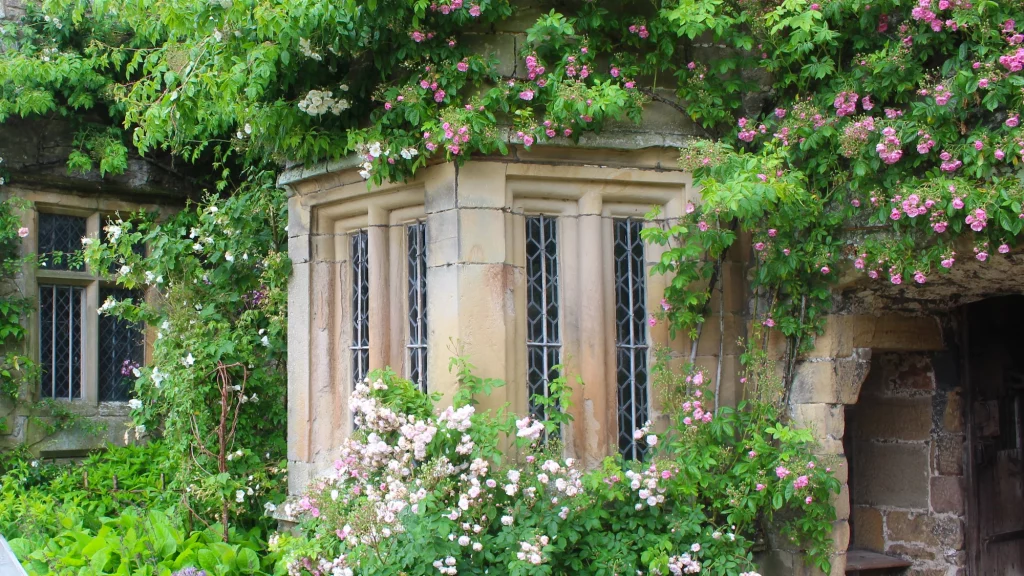
The grounds are nowhere near as large as Chatsworth but are charming, particularly in June as the roses that line the walls are in full bloom. Many of the roses are 100s of years old. There is a very romantic feel to the gardens, the planting crossing the boundaries between formal and English cottage garden. The insides are steeped in history, but are empty and somewhat devoid of life; it takes a good guide to help them come to life.
There are some real feminist touches to Haddon Hall. The old Norman chapel has an image of a woman teaching her daughter to read in the stained-glass windows, and the Elizabethan hall has a poem by a female poet etched onto one of the windows.
I feel I must note here that the entry price, once the parking is considered, is similar to that of Chatsworth despite the property and grounds being significantly smaller. I overheard some fellow visitors over breakfast expressing the view that the visit had not represented good value for money and I would tend to agree. It is no doubt extremely expensive to maintain a building of such age, but if you are a traveller on a budget then Chatsworth represents far better value for money.
Bakewell Derbyshire
The nearby town of Bakewell is the only town within the Peak District National Park; the town of Buxton being surrounded by the Park but not actually in it. Bakewell is a charming town that seems to fully represent England, from its pubs with flowery hanging baskets, to the ducks on the river by the stone humpback bridge. The church on the hill has the sort of graveyard you think only exists in movies. In fact, much of this part of Derbyshire feels like a film set.
Next to the church is a small, but rather interesting museum in and of an old Tudor house. This is a fascinating exposé as to what a normal household might look like, contrasting with the lifestyle of the upper class occupants of Haddon Hall.
There are plenty of small shops, restaurants and pubs in the town and two very good cheese shops. There are several cheeses made in the area including the very delicious Dovedale Blue. Unfortunately, yet again, the weather was not on my side with a constant drizzle making sauntering an unappealing prospect.
Ashford in the Water Derbyshire
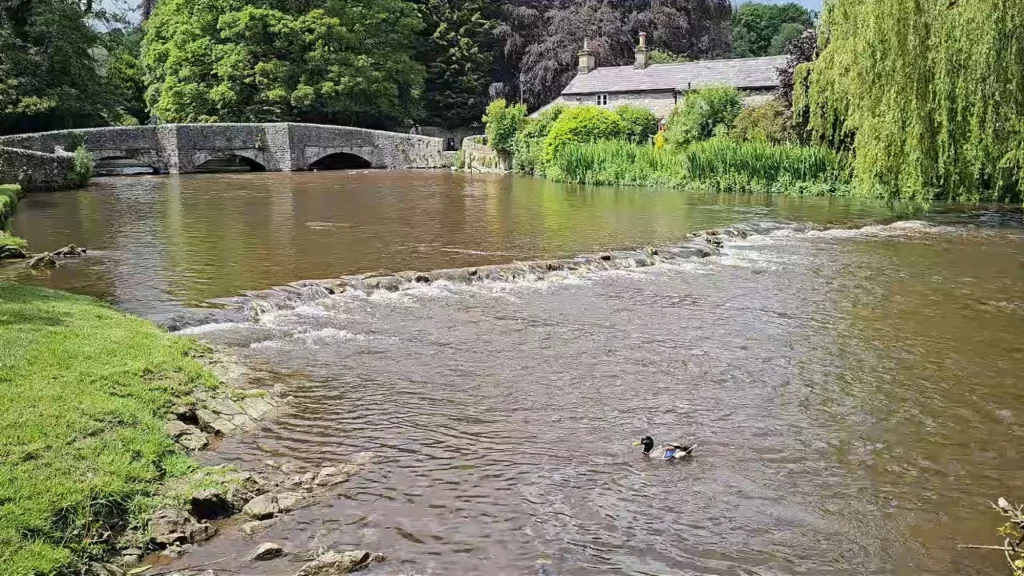
The pretty village of Ashford in the Water made for a lovely stop for lunch. Once off the main road the village is like a picture postcard, complete with rose covered cottages, a Norman church and a medieval bridge that was voted the best place in England to play Pooh Sticks. The Bulls Head pub serves some excellent food (if a little generous on the portion size), and the friendly welcome was a good example of the hospitality I received in Derbyshire.
Monsal Trail Peak District Derbyshire
Not far from Ashford is the Monsal trail, a traffic-free trail along an old railway line. It is great for walkers and cyclists and it is accessible for pushchair and wheelchair users. I parked up at the Hassop Station, which has been converted into a restaurant/café and bicycle hire shop, and picked up and electric bike. The route is 8.5km and is a linear route, but does join up with other trails.
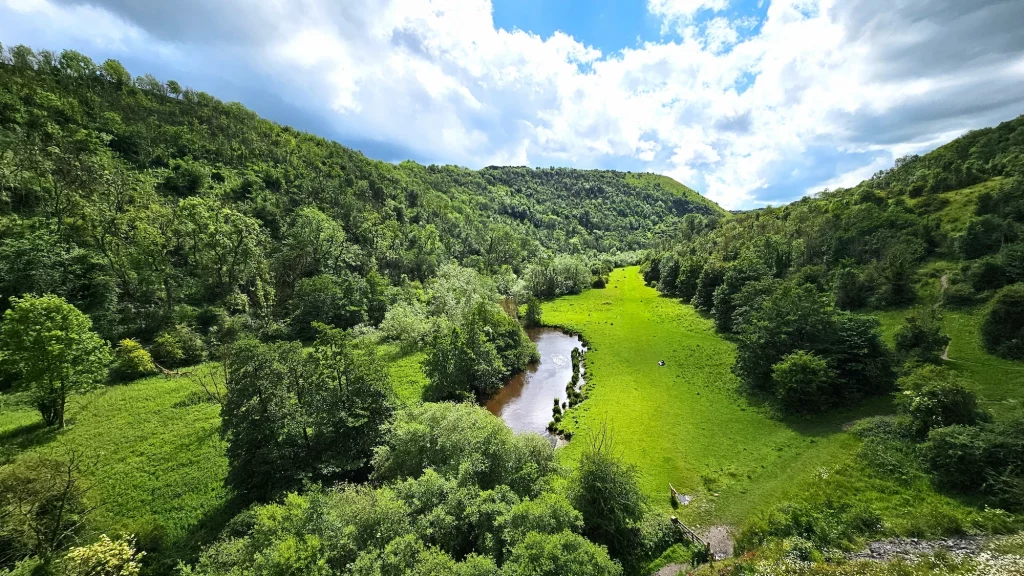
It was a pleasant ride, fortunately the drizzle stopped just in time. It has the peculiarity of taking you through several railway tunnels, which is a strange experience on a bicycle. The change in temperature as you entre the tunnel is striking.
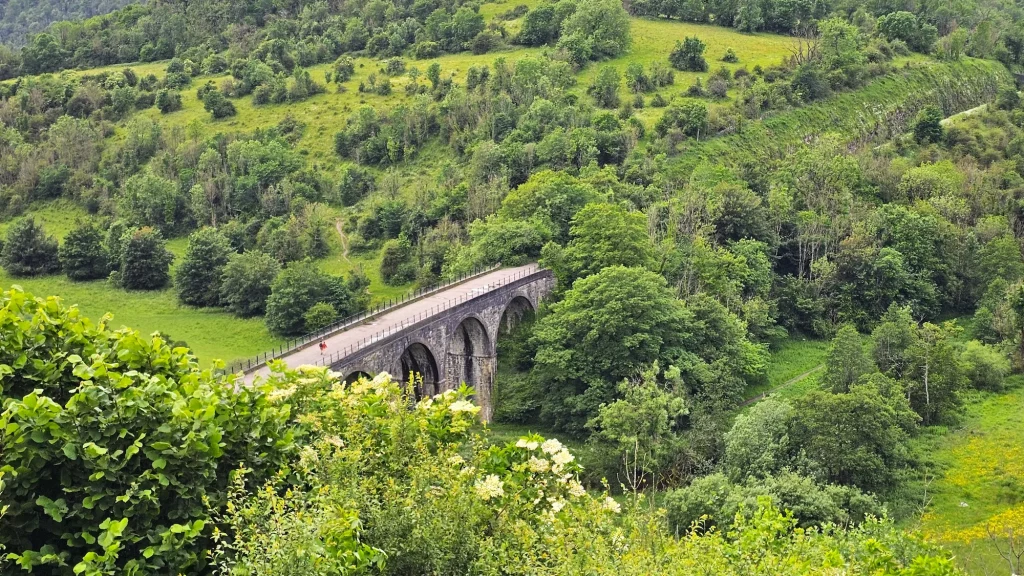
You get some nice views along the route, but the best view is actually from high above the trail at Monsal head, where you can really appreciate the viaduct and the surrounding hills.
Buxton Derbyshire
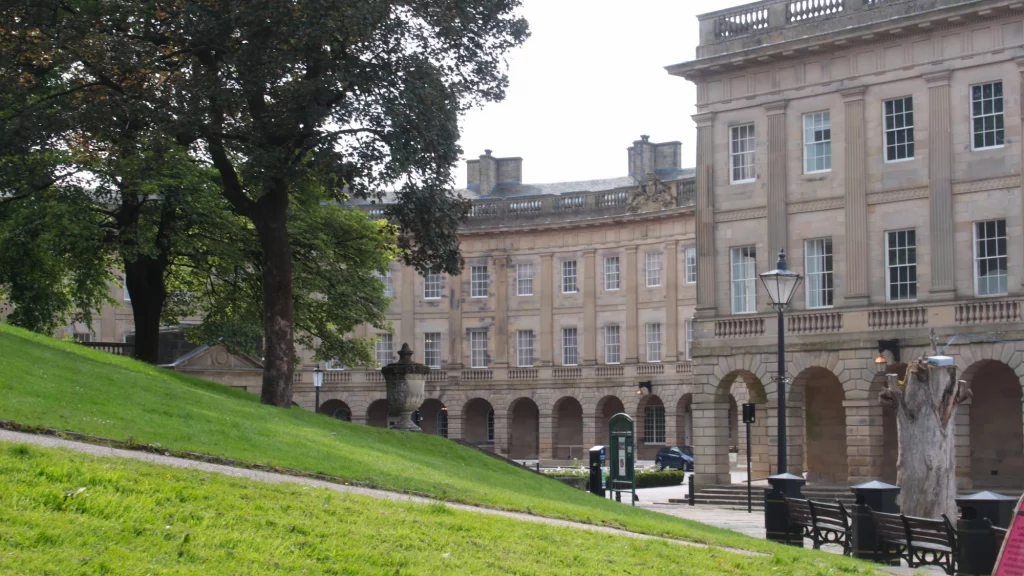
Buxton has a somewhat different feel about it when compared to the surrounding area. It is the highest town in England at an altitude of over 1000ft (300m) and is best known for the natural mineral water that bubbles up from thermal springs. It has been known as a bathing spot since Roman times and over the years many people took pilgrimages there to bathe in the waters which are thought to have healing properties. Mary, Queen of Scots was a regular visitor. The 18th century saw significant development in the town. In particular, the building of The Crescent, a Georgian arc-shaped building designed to mimic the Royal Crescent in Bath. In fact, the Royal institution of British Architects describe the Buxton version as more richly decorated and altogether more complex. Built by the 5th Duke of Devonshire (of Chatsworth house) to incorporate a hotel as well as a grand assembly room it now houses the Buxton Crescent Spa hotel run by Champneys.
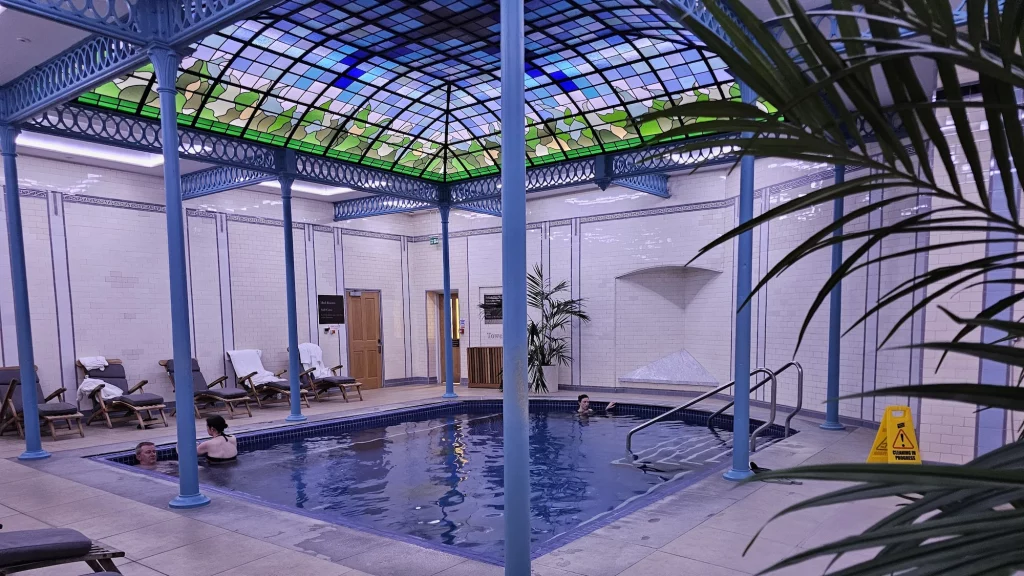
You can still bath in the Buxton water at the spa, under a stunning stained-glass roof. I don’t know about the healing properties of the water, but it is certainly a very relaxing experience.
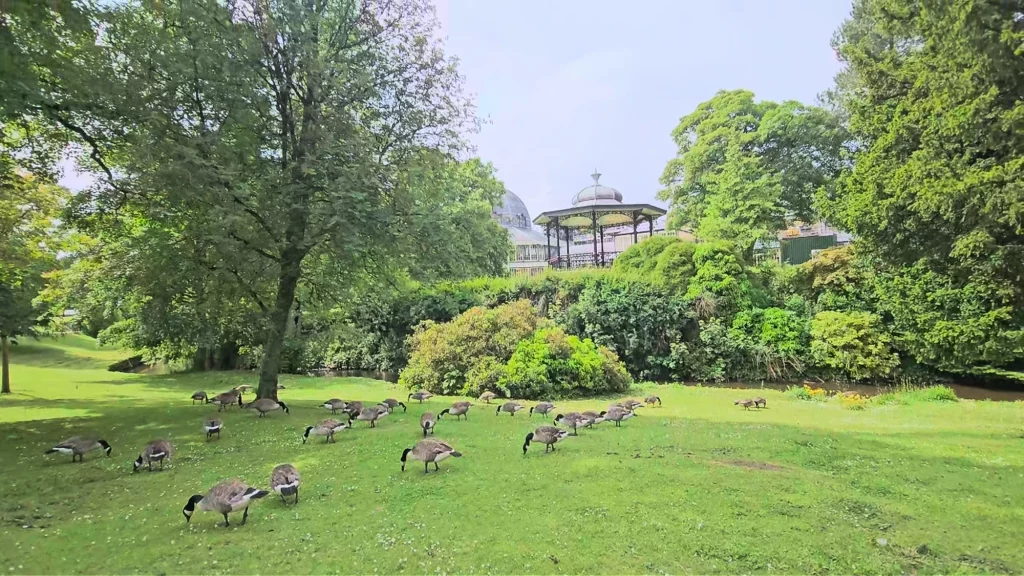
The Victorians also played their part in shaping Buxton into a classic spa town, with the completion of the Pavillion Gardens. This 35-acre park, which Bill Bryson said “must be the most delightful town park in the country” is overlooked by the pavilion buildings with a café and glass house in classic Victorian style.
The river Wye runs through the park, which boasts lakes and fountains. The birds certainly seem to enjoy it as there are a wealth of our feathered friends in the park including a rather large number of Canada geese.
Mam Tor Peak District Derbyshire
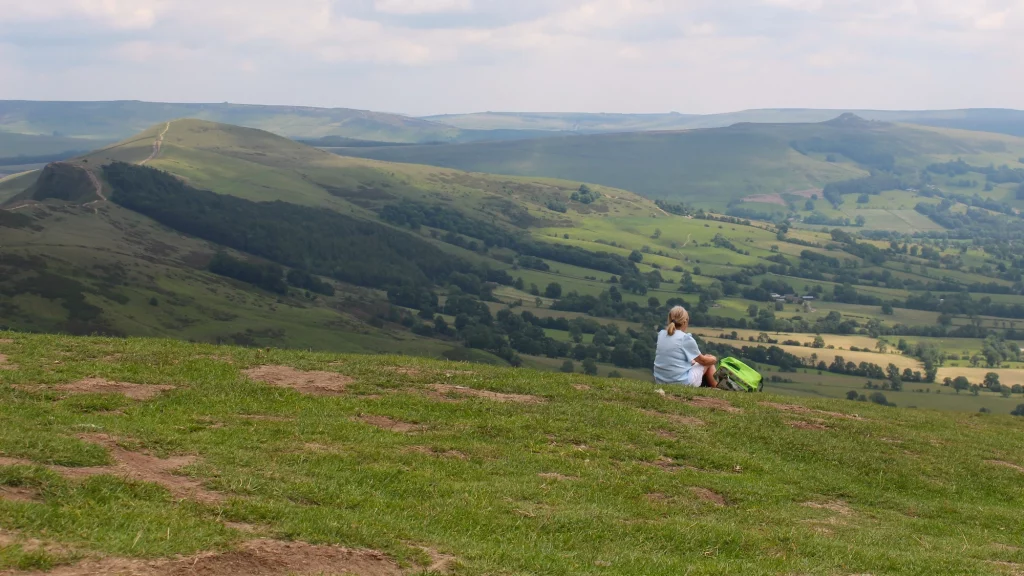
The peak district is an area of outstanding natural beauty. It is a paradise for walkers and ramblers. There are walks to suit all abilities. I chose to climb to one of the most popular spots in the area – Mam Tor. It isn’t the highest hill in the area, but it is the most popular given its accessibility and staggering views. I took the short 5km route from the Mam Nick car park. It is a steep climb but totally worth every step. The way up is well signposted and the views from the top are breathtaking.
If you are going during school holidays, then get there early as it gets very busy and the car park is not very big.
Treak Cliff and Blue John
You can extend the Mam Tor walk, and start from some different spots, including Treak cliff. This triangular shaped hill is unique as it is the only place in the world where you can find the semi-precious mineral known as Blue John. Once popular in the 19th century for ornamental objects, examples of items made from Blue John can be seen at Chatsworth. You can visit the mines at Treak Cliff Cavern. Rather than a guide there is an app that you download onto your phone that gives you an audio guide as you walk through the tunnels and caverns. It was an eery feeling going down totally on my own, and I was somewhat reassured when I encountered another group part way down. It is fascinating to see the old mines and the natural structure of the rock. The recent rainfall permeates into the stone so there is a constant drip-drip from the ceiling.
Castleton Derbyshire
The village of Castleton which sits just below Treak Cliff is one of the most popular, and the most photographed and painted in all of Derbyshire. As I walked into Market place I came upon a group of artists, sketching and painting the idyllic setting. Such a lovely way to while away an afternoon under the shade of a chestnut tree.
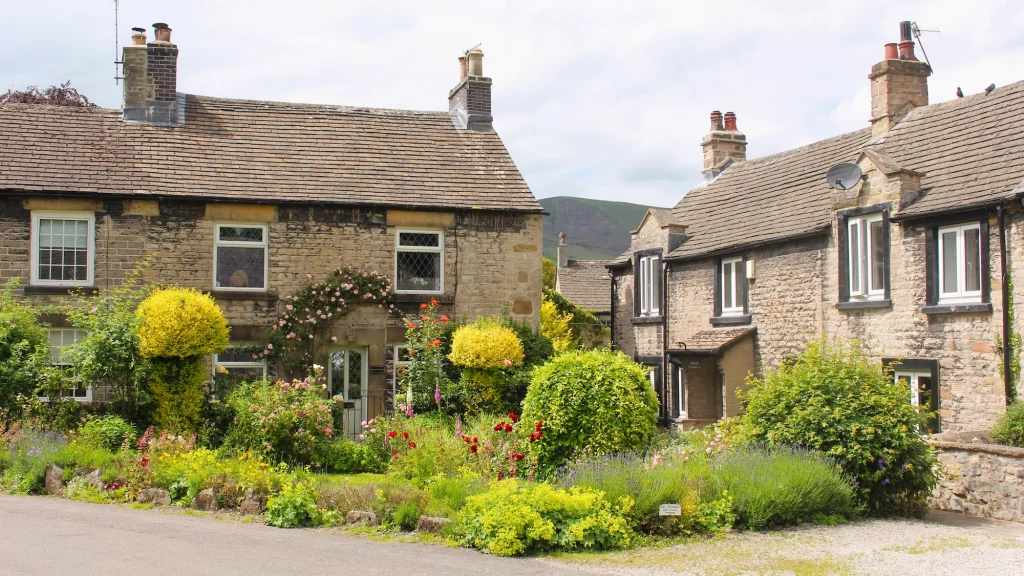
The ruins of the 11th century Peveril castle sit above the village. The spectacular hilltop castle once served as a base of government for the local area and is now looked after by English Heritage.
The Castle pub in the village had one of the nicest beer gardens, with a view out to the surrounding hills.
Is Derbyshire worth Visiting?
I believe Derbyshire to be one of the best regions of England to visit. The Peak District is good for both walking and exploring some of the finest houses in England. Superior, in my view, to the Cotswolds. Buxton has an elegance about it that easily rivals places like Bath. Derbyshire seems to showcase the best that England has to offer. I had some excellent food (especially at breakfast; you can hear more about that on my podcast) and the hospitality I received was universally warm and welcoming. It is just a shame that the weather isn’t always as obliging!
If you are planning your first trip to Europe then make sure your read How to plan a trip to Europe: the 3 essential first steps

If you need help with planning your trip then check out our services

If you have any questions about travel itineraries in Europe then drop us a line.  We are happy to help.

If you want more tips and ideas for visiting Europe then FOLLOW ME ON INSTAGRAM