
I was somewhat surprised how much I got sucked into to the history of Budapest, and how much that history has shaped the city as it is today.
Much of this interest came from the tour I did on my first day in the Hungarian capital, and I highly recommend doing it in this order as it gives so much context to everything else I saw in Budapest.
The tour I took was from Budapest Explorers, called Secrets of Buda Castle. This is essentially a walking tour of the castle district on the Buda side of the river. Our historian guide, Judit, made it so much more than that. She gave us a potted history of Budapest, in an accessible and easy to understand way, one that made me eager to know more. She told us of a nation repeatedly being controlled by external forces and one that is struggling to forge its modern, independent, identity.
Saint Stephen : Budapest’s Founding King
The story started in 896 (this date is an important one for the Hungarians) by the Magyars, a semi-nomadic people who crossed the Carpathian Mountains, liked what they saw and decided to stay. The first King, Stephen, was crowned using a crown gifted by the Pope which aligned Hungary with Rome and fixed Hungary with the structure of a western medieval kingdom, with the churches and monasteries that go along with that. Such was his import the nation wanted him canonised but didn’t have enough evidence of miracles, so they dug up his body and found his mummified hand (but not the rest of his body). This itself was seen as a miracle and was enough to rise King Stephen to the ranks of sainthood.
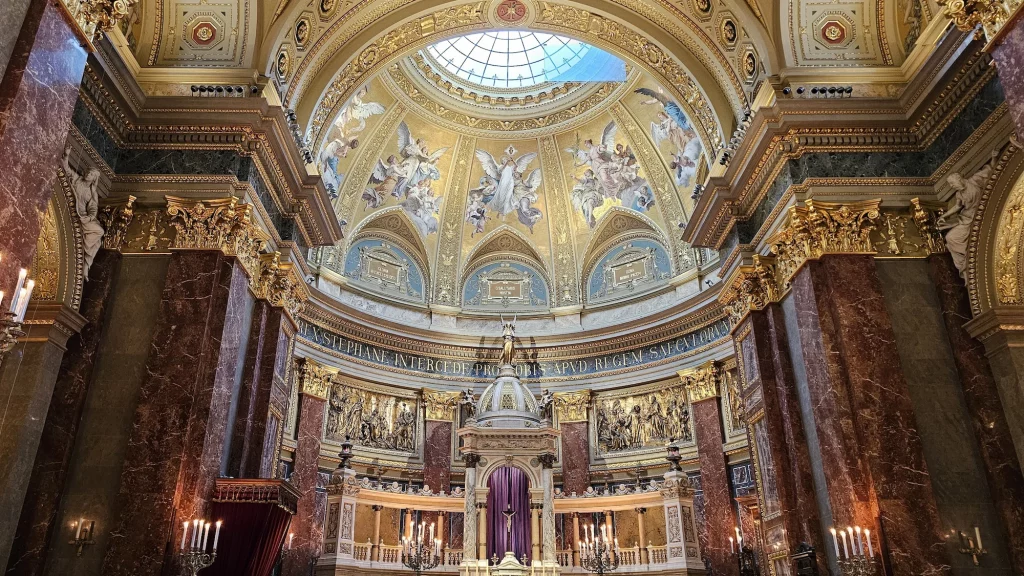
King Saint Stephen is probably the most physically present historical figure in Budapest. The Basilica is named after him (see my review of the hotel next to the Basilica) and that is where you will find his mummified hand. The church is astounding in its beauty, one of the most striking I have ever visited. Although it has to be said the hand is not exactly pretty, hardly surprising given its age. The canonisation of St Stephen was so important that to the day the date, 20th August, is Hungary’s national holiday. Every year the holy right hand is paraded through the streets and there are fireworks on the Danube.
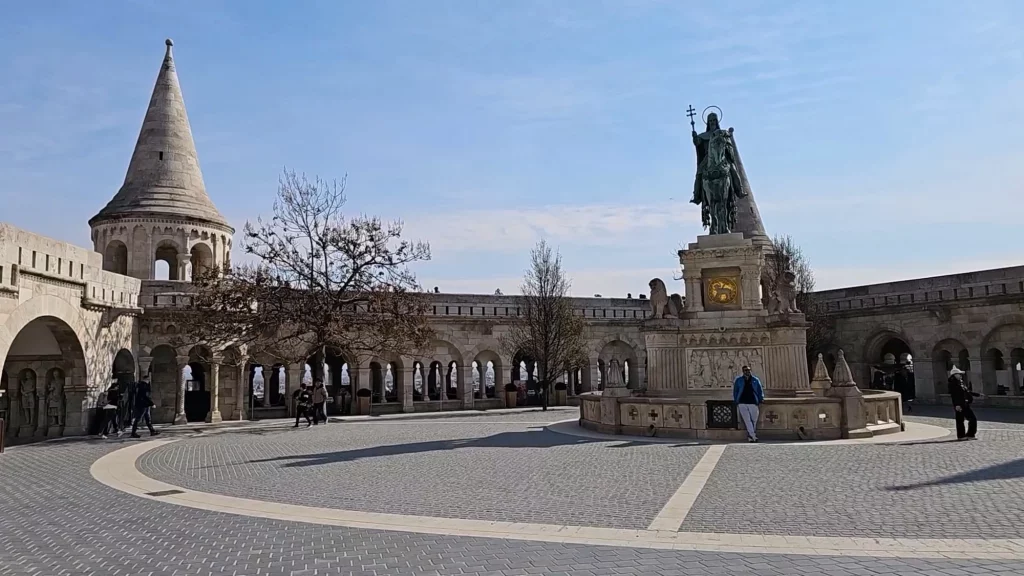
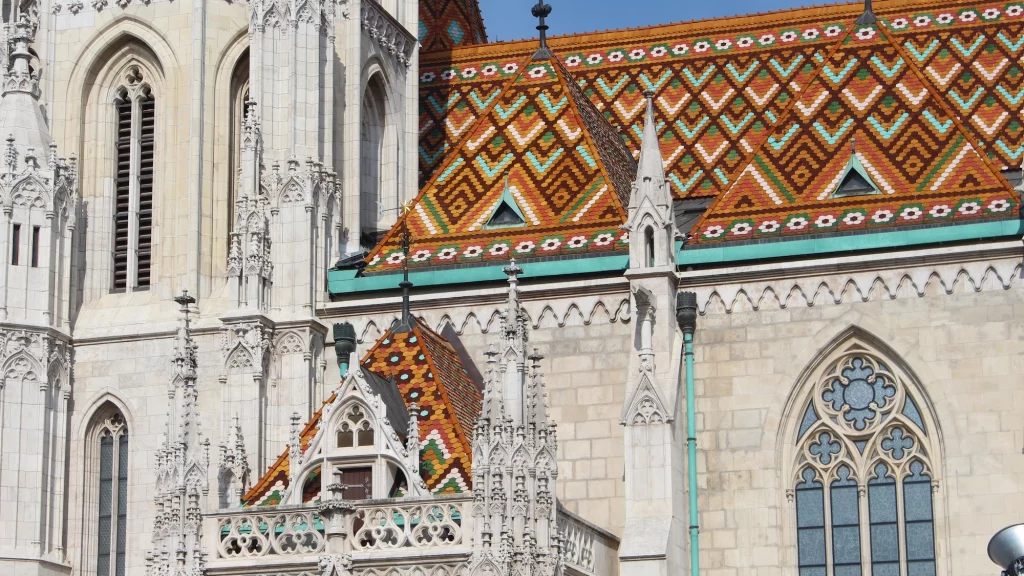
The statue of St Stephen on a horse dominates the square between the Fisherman’s Bastian and the church, but it is the church that deserves all the merit here. The church of the Assumption (sometimes called Church of Our Lady) is more commonly known as the Matthias Church in recognition of the bell tower King Matthius had built in the 15th century. This is one of the finest pieces of gothic architecture in Hungary.
King Matthias and Budapest’s Golden Age
King Matthias is held up as being the King of the golden age of Hungary. A time when Hungary was at the forefront of European renaissance culture and had an enviable army. He died without an heir and Hungary never really recovered.
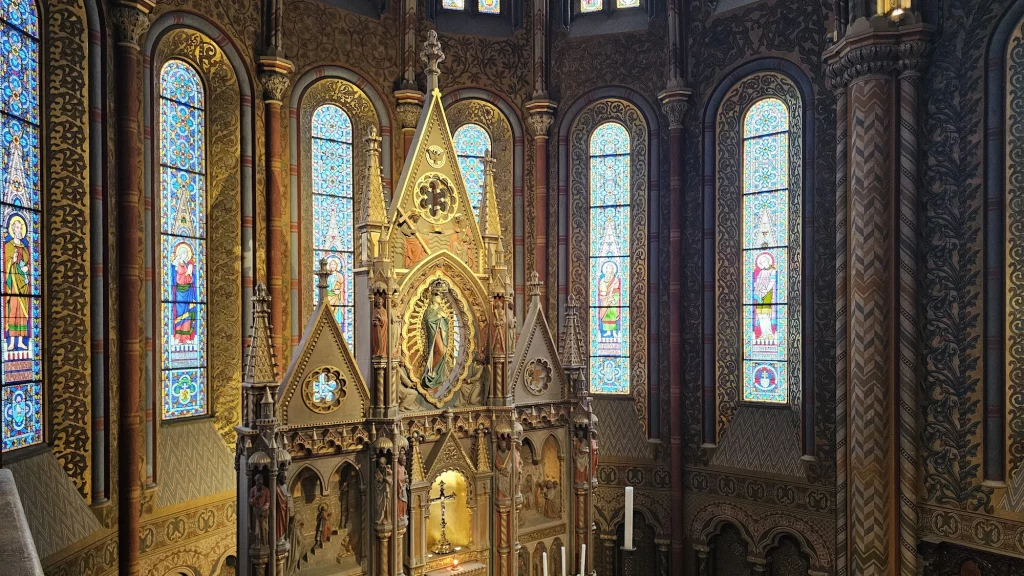
The church itself is “only” a church, not a cathedral, but it is more impressive than many cathedrals I have seen. It has a checkered history that follows the history of Hungary. After the golden age of Matthias, the Ottomans took over Hungary, and the church was used as a mosque for 150 years and following that a Jesuit church. It was then fully renovated to match with the status of the Hapsburgs for the millennium celebration (we’ll talk about this in a minute) and the coronation of Kings Franz Joseph.
The paintings all over the walls of the church brought to mind the Islamic decoration of the Palace of Alhambra, rather than that of a Catholic church, but they are all a result of the Hapsburg renovation. The Ottomans whitewashed over the original paintwork when the building was used as a mosque.
The Ottoman Legacy in Budapest
Despite 150 years of rule there are few visible remains of the Ottoman’s rule in Budapest. The city was badly damaged by the 1686 siege that ended the Ottoman period and what was left of the mosques and minarets were later destroyed by the Habsburgs. One part of their legacy that did remain, and is an important part of Budapest for travellers today, is the thermal baths.
The Ottomans weren’t the first people to use the natural thermal springs in the area for bathing; that distinction belongs to the Romans. But until the Ottomans came along the baths had been little used for a millennium. Three of the original 80+ Ottoman structures survive today. Whilst the Kiraly baths (the oldest in Budapest) is currently closed for renovation, the Rudas baths and the Veli Bej baths are original Turkish baths which are open to the public.
Habsburg Budapest : from Liberation to Control
During much of the time the Ottomans were ruling in Budapest (or rather Buda as it was at the time) the Habsburgs – head of the Austrian Empire – held the northern and Western parts of the country and were recognised as the Kings of Hungary. The 1686 siege changed that, turned Buda over to the Austrians, and eventually pushed the Ottomans out of the country. So yet again Budapest was under the rule of an external force.
The Habsburgs weren’t really that interested in Budapest as a seat of power, they ruled from Vienna, but they did build some churches such as the Saint Anne Parish Church, also in the Buda castle district. It was a time when the Catholic Church reasserted themselves in Budapest.
Whilst the Habsburgs controlled and ruled Hungary, much of the domestic governance was left to the Hungarian Nobility and the Palatine, a royal governor. The Habsburgs gave land left by the Ottomans to the loyal Hungarian nobility which helped to maintain control. It was not a comfortable relationship, and political uprisings and revolt were not unheard of.
Born in the midst of this was a man who came to shape Budapest into a major cultural, economic and politically important city. Count István Széchenyi was born in Vienna to a Noble Hungarian Family. He wasn’t the eldest son; in fact, he was the youngest of their children. He joined the Austrian army and fought in the Napoleonic wars before coming back to Hungary to fight for reform. He established the Hungarian Academy of Sciences, improved the navigation of the Danube to open it up to commercial shipping and supported the construction of the first bridge between the two cities of Buda and Pest, leading the way to later unification.
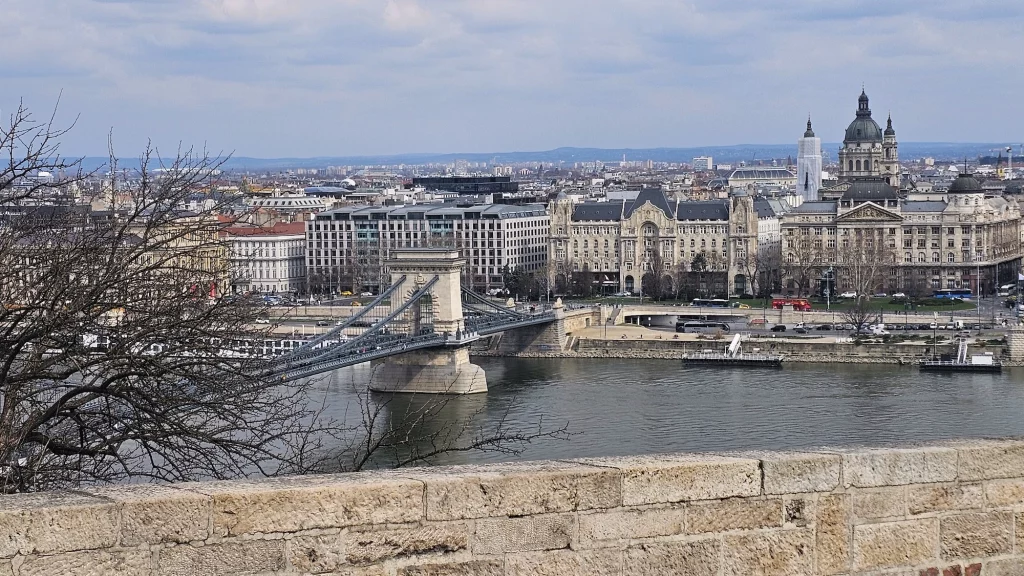
The iconic chain bridge carries the name Széchenyi. The famous thermal baths are named in his honour, but they were built long after his death.
Széchenyi never recovered from the trauma of a failed revolution in 1848 and died in 1860 just 7 years before the political compromise his movement was fighting for.
The Austro-Hungarian Empire and the Making of Modern Budapest
The 1867 political compromise gave Hungary self-governance and a shared monarch. It is from this point the “Austro-Hungarian Empire” acquired its name. That said, our history guide was very much of the opinion that the union was not an equal one. It did however lead to a time of great prosperity for Budapest. The decades leading up to the first world war saw much construction and, particularly on the Pest side, gave us the city we see today.
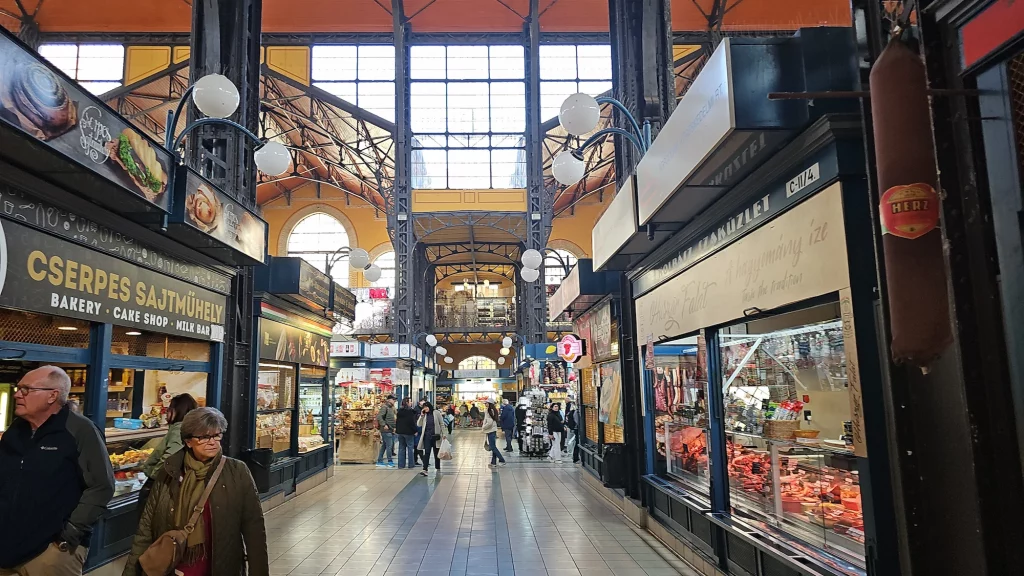
Much of this building work was done as a celebration of the Millenium, that is 1000 years of the country of Hungary. Not just The Fisherman’s Bastion which we saw as part of the tour, but also the Millennium underground (Europe’s first metro) Hero’s square and the central market hall were all built for the 1896 Millenium Exhibition. Even the Vajahunyad Castle was part of it. Originally built out of cardboard and wood for the celebrations it proved to be so popular that it was rebuilt from stone and brick.
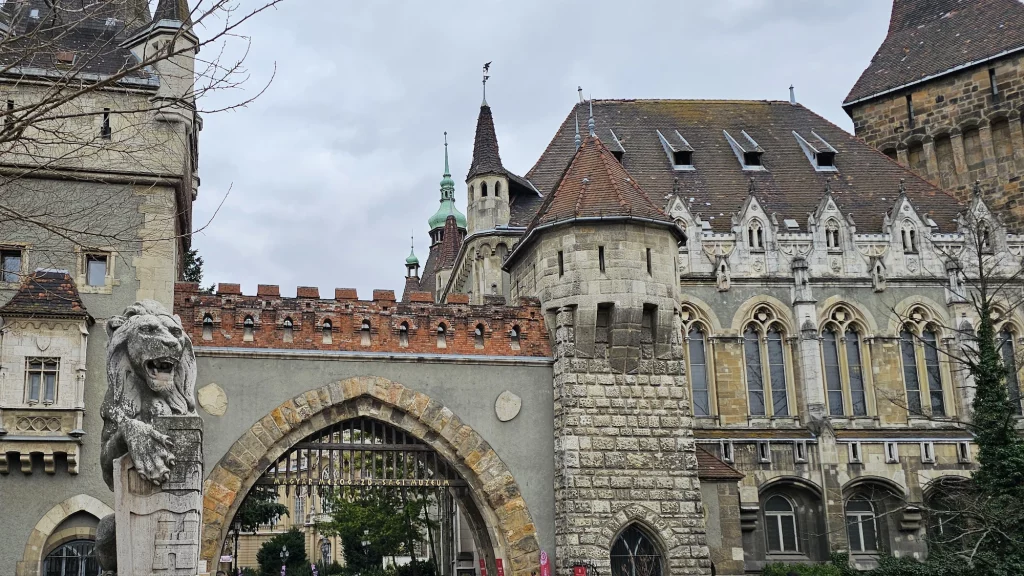
This explains a lot about the look of the castle, which is an eclectic mix of architecture styles designed to represent different landmark buildings across the country. It is now home to the Hungarian Agricultural museum.
The Treaty of Trianon: Hungary’s National Trauma
The first world war had a catastrophic effect on the country of Hungary. As part of the Treaty of Trianon two thirds of its territory were taken from the country and given to Romania, Czechoslovakia, and Yugoslavia. This included areas like Transylvania which are deeply and intrinsically tied to Hungarian history. Some traditional food and culture which is referred to as being “Hungarian” comes from these areas.
For Budapest it meant that the infrastructure that had been built for the capital city of a country of 325 000 square kilometres, was now head of a state roughly a third of that size. Added to that, many professional middle classes from the cut off regions, came to the city as refugees. As many as 400,000 people poured into the city, representing a third of the resident population. This was at a time when the economy was in tatters; industries had been broken up by the new frontiers and lost their supply chains as raw materials were now outside the borders.
Another significant part of this movement of people was the effect it had on the Jewish population of the city. Before the war Jews represented nearly 25% of the population of Budapest and held many of the professional and commercial roles. The influx of a large number of educated middle class into the city had disastrous consequences on the Jewish community. Very quickly, Jewish university admissions were restricted, and further controls came into place in the decade that followed. This collision between nationalist Christian Hungarians and the Jewish community can be felt throughout the city, but in particular in the Jewish quarter.
The Second World War and the Holocaust in Budapest
When the second world war started Hungary sided with Nazi Germany, in part with a hope of recovering the lost territories. The final year of the war, when the Hungarian government tried to negotiate a peace treaty, resulting in German occupation of the country, was probably the worst year in Budapest’s history.
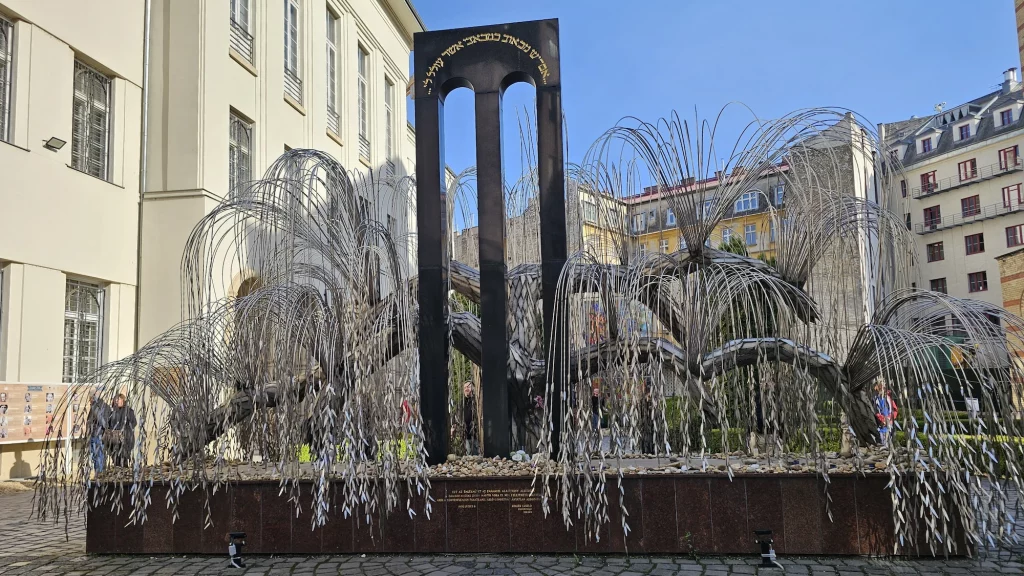
In the space of under two months 440,000 Jews were deported from Hungary, mostly to The Auschwitz camp. About 80% were gassed on arrival. The holocaust memorial at the central Synagogue holds details of what happened as well as a memorial tree with the names of many of the victims engraved on the leaves of a weeping willow tree. The Synagogue also holds the mass graves of the 2000+ Jews, mostly women and children who had escaped the camps but died in the ghetto where they had been shut up with limited access to food and water.
On the banks of the Danube you will come across the “Shoes on the Danube bank” memorial. The commemorates the 20,000 Jews that were taken from the ghetto in December 1944 and January 1945 and shot at the edge of the water. Shoes were removed as they were valuable. It is a touching memorial, but I feel it could be better looked after, with more information about the terrible atrocities. It is in grave danger of becoming little more than a selfie spot.
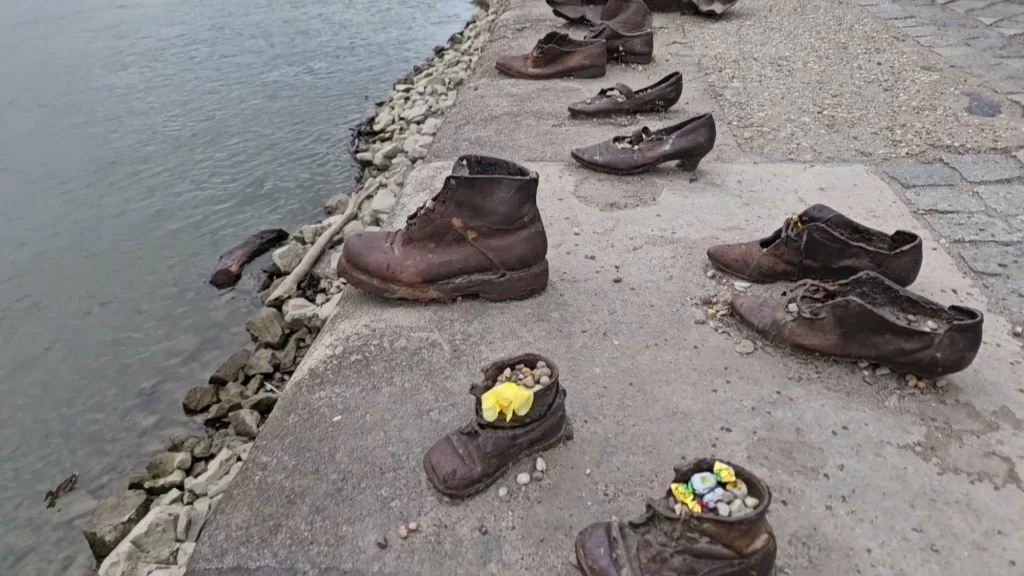
All of these atrocities were carried out with the help of the Hungarian police and Gendarmes and not just the German SS, making it a difficult part of the city’s history to confront.
On top of this came the destruction resulting from the siege of Budapest by the Red army and the Romanian army. Between 26 December 1944 and the liberation by the Red Army on the 13 February 1945 80% of Budapest’s buildings were damaged or destroyed. All of the bridges over the Danube were demolished by the Nazi army in an attempt to slow down the Red army. Weeks of street by street fighting destroyed much of the city. The Buda castle district was particularly badly hit, with many buildings completely destroyed.
The Matthias church was severely damaged in the battle; the Germans used it as a field kitchen and the Soviets as a horse stable. The fact that we can visit it today in all its splendour is remarkable. The presidential Sandor palace and the neighbouring office of the prime minister are fully renovated. The rest of the Buda district is still, to this day, under reconstruction. The National Hauszemann program plans to restore the area. The scaffolding on the ministry of the interior building and Archduke Joseph’s palace turned ministry building had been removed just a couple of weeks before our visit. And there are multiple other buildings being renovated or rebuilt in the area.
Soviet Budapest
After WWII Hungary, and Budapest, found itself once again controlled by external forces, this time the Soviets. The communist rebuilt some of what the siege destroyed, but very much on their own terms. The outside of the royal palace for example was reconstructed to its post-war appearance, but the inside is decidedly soviet institution style. The suburban areas of Budapest are dominated by vast swathers of soviet era housing blocks, which still house a large percentage of the population.
The statues that the soviets were so keen on covered the city. They have since been moved to Momento park where they serve as a sort of idealist’s graveyard.
One exception to this is the liberty statue which stands on Gellert hill. I have heard several reasons as to why it wasn’t removed, from the fact it was too big to the fact that the people of Budapest quite like it. First erected in remembrance of the Soviet liberation of Hungary, the Inscription has now been changed to “To the memory of those all who sacrificed their lives for the independence, freedom, and prosperity of Hungary”
Budapest Today: From Soviet Outpost to European Capital
The last decade of the twentieth century and the first couple of the twenty first have seen Budapest go from being a Soviet outpost to being a major European capital. Sitting on the Danube gives it clear comparisons to Vienna and membership of the EU has brought a service-oriented prosperity.
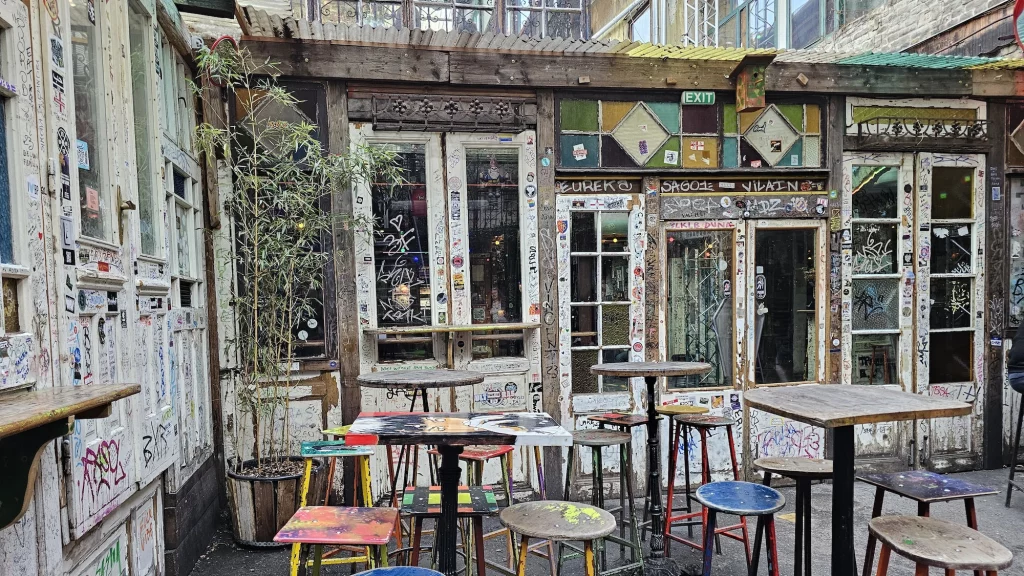
Initially a lack of money and a surfeit of dilapidated buildings, particularly in the Jewish quarter, led to enterprising souls opening up bars in the ruins of old buildings, cobbled together with whatever they could find. The result is surprisingly atmospheric, part squat, part modern art gallery. Nowadays these bars are a tourist draw, and the neighbourhood is now one of the most visited in Central Europe.
Historic buildings have been restored, and the urban streetscapes have slowly been brought back to what they once were. But the rejuvenation is still ongoing and there is plenty of growth left to have. Visitor numbers increased by 24% in 2024 and the city now gets around 6 million visitors every year.
Why History is Important When Visiting Budapest.
Europe is an old continent, so every city is going to have been shaped by its history in one way or another. But I have never felt it so keenly as I did in Budapest.
There are so many layers of history that make up this city. From the strong leadership of King Saint Stephen and King Matthias who are both clearly revered. Through the importance of the Thermal baths in the Ottoman era which are helping draw tourists to the city today. The Austrians built up the city only for two world wars to knock it back down and tear it apart. The soviet era kept it down only for it to fight its way back up determinedly. Budapest feels somewhat like a city in adolescence, which plenty of opportunity for growth. But it also is sitting on the threshold of further political turmoil. My visit took place a few weeks before the national elections, the result of which could change the future of the European Union. The mood when we were there was cautiously optimistic, but many people we met said they were nervous to hope in case it was in vain. Given their tumultuous past I can hardly blame them.
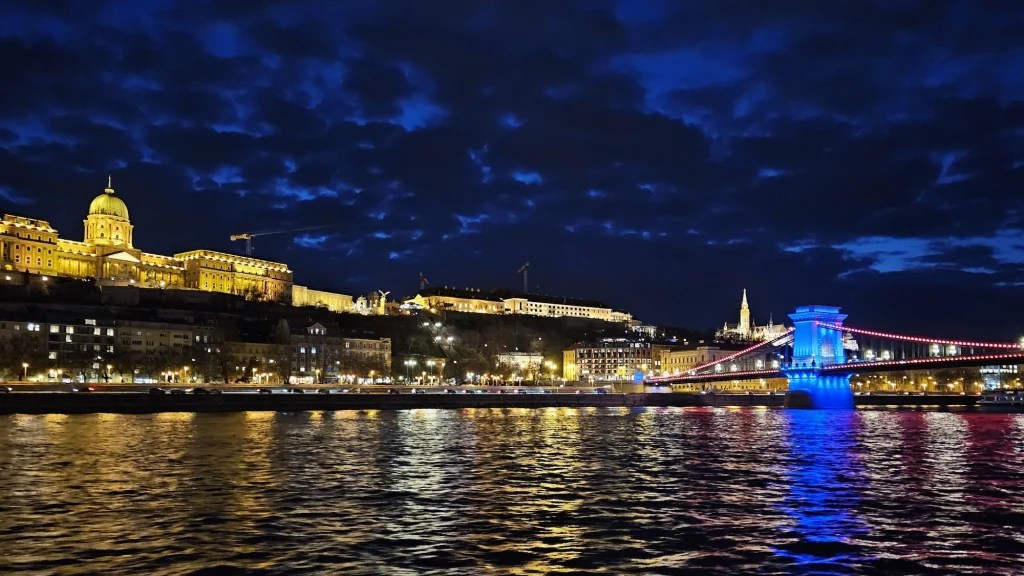
Without the walking tour at the start of my trip, I would probably have missed much of the significance of the buildings in Budapest. It is a city with a powerful story and knowing some of that story makes a visit here so much more powerful.
If you are planning your first trip to Europe then make sure your read How to plan a trip to Europe: the 3 essential first steps

If you need help with planning your trip then check out our services

If you have any questions about travel itineraries in Europe then drop us a line.  We are happy to help.

If you want more tips and ideas for visiting Europe then FOLLOW ME ON INSTAGRAM
Pingback: A First Visit to Budapest, What to See and Where to Go