
The popular central market Mercado de San Miguel is closed for renovations, and no official date has been given for the re-opening. So, I thought I’d go and look for some alternatives.
I had seen Mercado de Vallehermoso recommended so I headed there first; taking the Metro line 2 to Quevedo and then a 5 minute walk. I recognised the entrance from a video I had seen, otherwise I’m not sure I would have entered as it didn’t look very welcoming. Those impressions didn’t particularly improve inside. It was about 10:30am on a Thursday morning. The information I had was that it opened at 9am and I could find no indication that it wouldn’t be fully open on this particular day. There were very few stalls open and hardly any customers. I didn’t even get my camera out I was so disappointed. Plenty of the information I see on line implies that this is a lively market, so I was surprised. Looking further into it seems that the Mercado de Vallehermoso is more of a gastronomic market rather than a produce market, and as such, even though it is officially open in the morning, it doesn’t really get going until after 14:00 and it is much livelier at the weekends. Visitors should bear this in mind if they decide to make the trip.
I started to think perhaps no-one goes to markets on a Thursday. Where I live in France markets have particular days (in our case Wednesday and Saturday) so this didn’t surprise me. This market isn’t a long way out of the centre, it’s about 30 minutes walk from Puerta del Sol or 5 stops on the metro, but that’s quite a distance when this is mostly a residential area with nothing much else to see. Certainly a far cry from the Mercado de San Miguel which is slap bang in the centre of things.
So, given that I had come this far I thought I would keep walking. The Madrid tourist site had led me to believe that the Calle de Bravo Murillo was a shopping street so I thought I would explore. Alas the 20 minute uphill section between the Quevedo and Cuatro Caminos had very little to offer the international tourist. A sofa shop, a couple of garages, and a print shop were the type of delights on offer. I did come across a rather nice fountain which seemed to be rather randomly placed on this street.
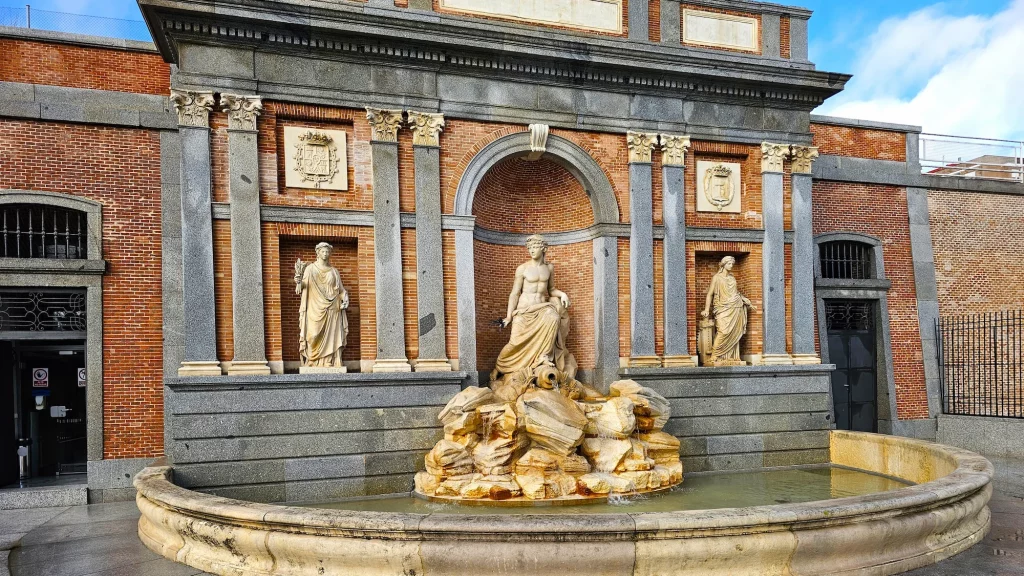
The Fuente del Río Lozoya was originally built to commemorate the project that brought water from the Lozoya River to Madrid. It has recently re-opened after extensive renovation works. I have seen this fountain described as the “Trevi fountain” of Madrid. This is an extremely ambitious description and I’m not sure whether the person who came up with it has never seen the Trevi fountain, or was just having a joke. It’s nice enough, but does not warrant a detour.
Once past the Cuatro Caminos the Calle de Bravo Murillo does take on more of an air of a shopping street. Although, in London terms, I would describe it as more like the Kilburn high road than Oxford street.
This street does however have one major advantage, and that is the Mercado Maravillas.
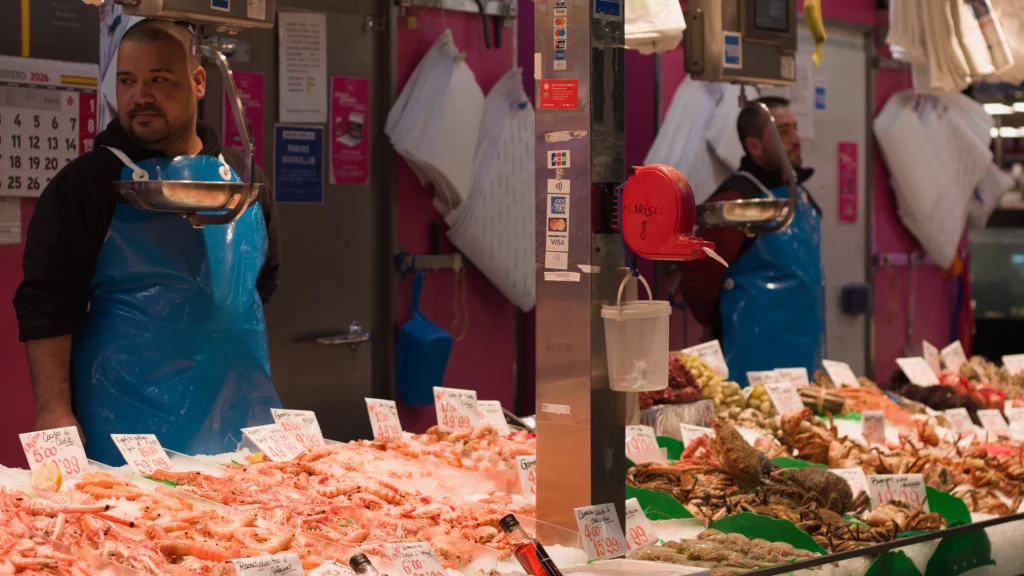
This is quite simply one of the best markets I’ve ever been to (and I’ve been to a lot of markets all over Europe). If I lived in Madrid I would do all of my shopping here. There is every type of fish, seafood, fruit, vegetables, meat and offal that you can think of, and several more you’ve probably never heard of.
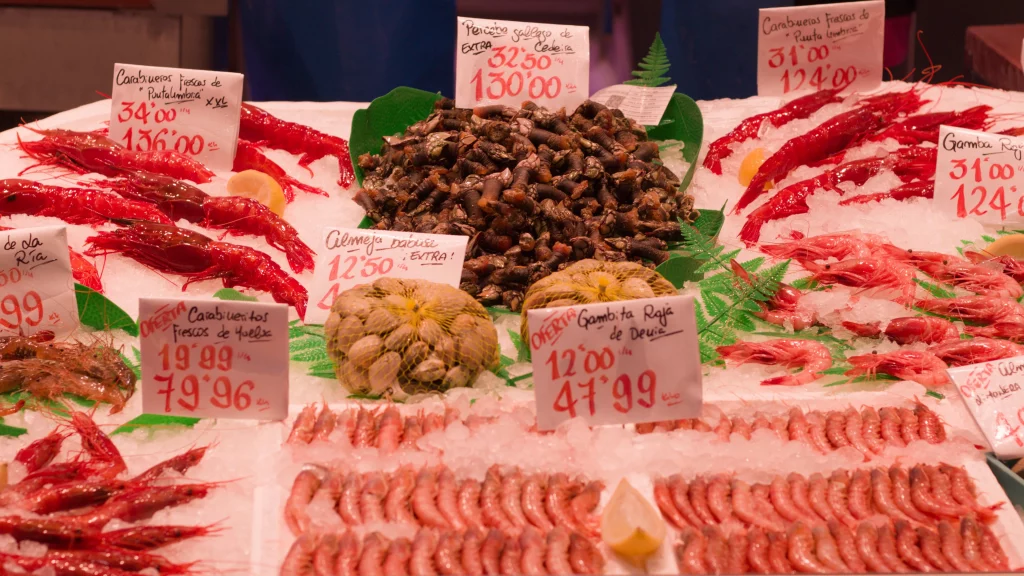
I spent a happy hour going up and down the aisles, soaking in the sights and sounds. It is a feast for the eyes (and the camera). This place is huge. Nothing like the smaller markets with a few stalls and some tapas places. It is clearly not aimed at the tourist. No stalls selling fruit smoothies or cones of cured meat. This is a market for local people, and no doubt local restaurants too given the amount of produce some people were buying. It was busy in the agreeable bustling sort of way. There were bars and food stalls interspersed in the grocery sections, filled with people having their almuerzo, the mid-morning snack that is essential when lunch isn’t until 2pm. These are relaxed affairs, barstools pulled up to a zinc counter.
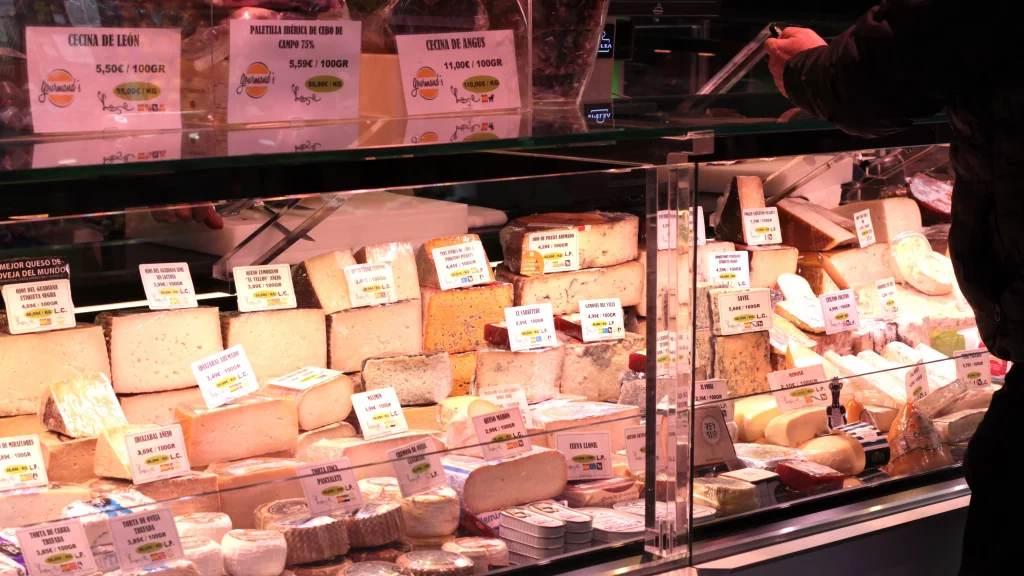
I don’t know exactly what it is that appeals to me about markets. Perhaps it’s the personal touch, there is no taking things off shelves, you have to ask and interact with someone. Perhaps it is the realness of it all. Nothing pre-packaged, everything is real and fresh. It’s a link to a past way of life. A reminder that, no matter how much we have moved forward with technology people are still buying their fruit from a market stall in much the same way as they would have done 2000 years ago.
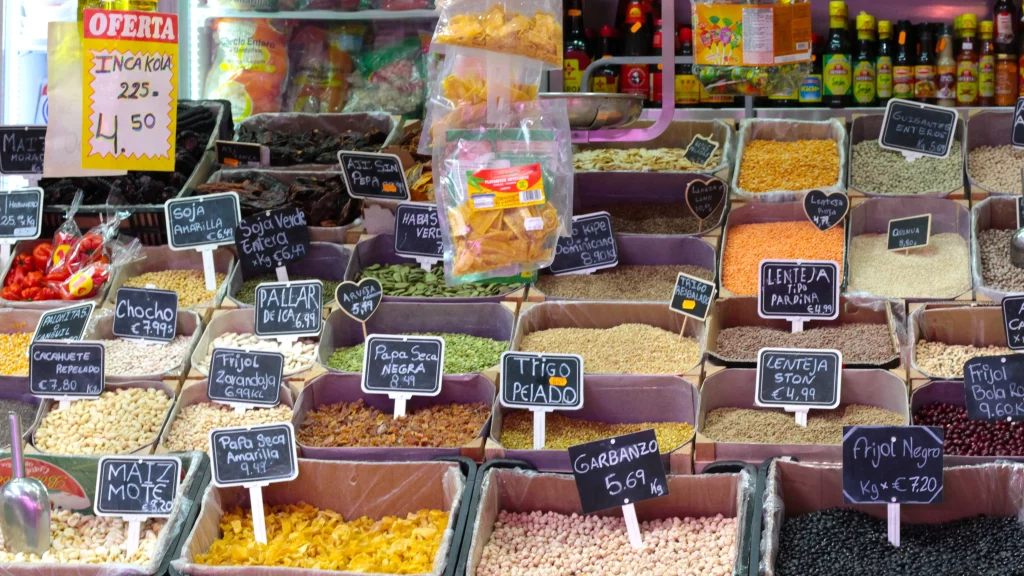
I’m not sure I can claim that the Mercado Maravillas is a replacement for the Mercado de San Miguel. To my mind it is something far better. It’s like seeing the original artwork rather than a poster reproduction made for a mass market. Each have their place but one is not a replacement for the other.
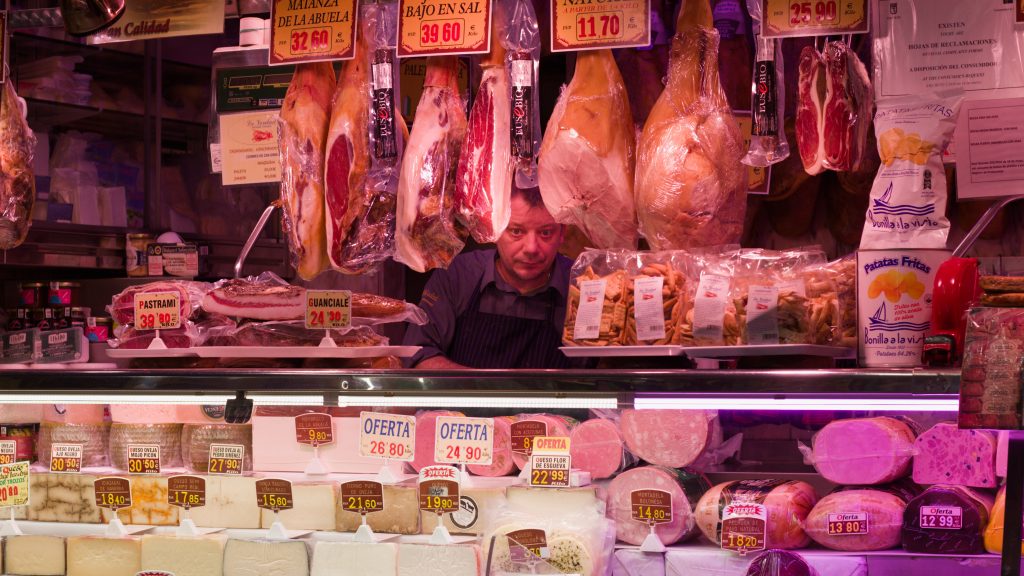
My interest was now fully spiked, so I visited three other markets during my trip to Madrid.
The Mercado de San Fernando in the Lavapies neighbourhood was even more closed than the Mercado Vallehermoso. The neighbourhood is a far more multicultural one, which in my experience often improves the markets. Alas not this time. I visited at 12:30 and the place was dead. In fact, all the shops around were also closed so for a moment I worried that there was a public holiday I had missed.
Walking away from the Mercado San Fernando in the direction of the Reina Sofia Museum I noted that the road leading between the Lavapiés metro stop and the Museum had a good choice of restaurants, and rather than the usual tapas bars, these covered a wide range of cuisines. I noticed African fusion, Italian and Argentinian restaurants as well as a café specialising in Matcha. If you are looking for something to eat after visiting the Reina Sofia museum this would be a good street to head for.
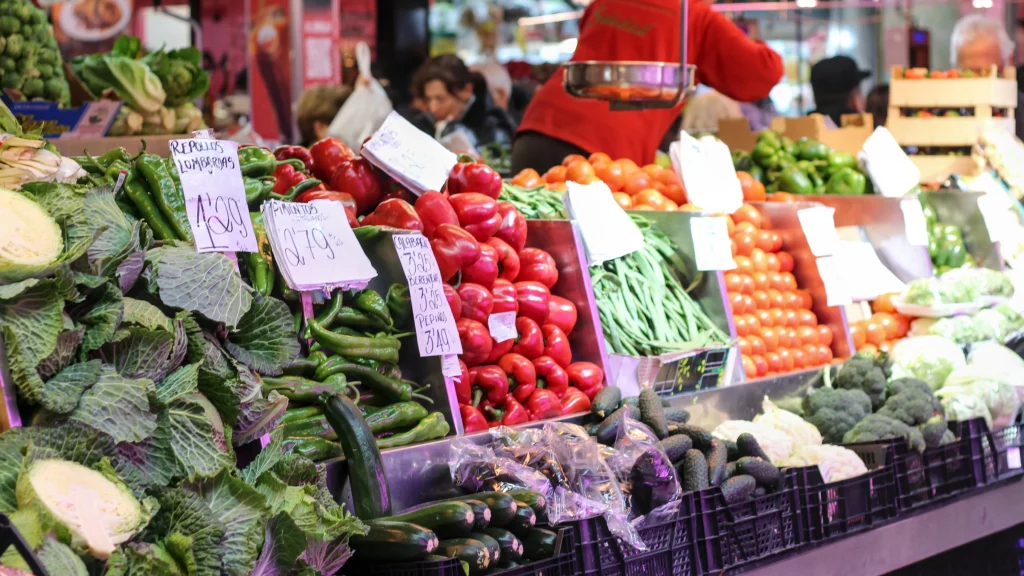
The Mercado de Antón Martín gets closer to an alternative to the Mercado de San Miguel. Walking from the Anton Martin Metro stop down the Calle de Santa Isabel you are treated to butchers and grocers’ stores before you even get to the market. These are mixed in with book shops and a couple of nice-looking cafés. The market itself is not huge. It has a mix of produce stalls and food stalls. I visited early and most of the food stalls were closed, but in that way that made me believe they would shortly be open. There was an atmosphere about the place that was missing in both the Mercado de Vallehermoso and the Mercado de San Fernando. I would very much like to revisit this market at another time. I imagine on a Saturday afternoon it must be buzzing.
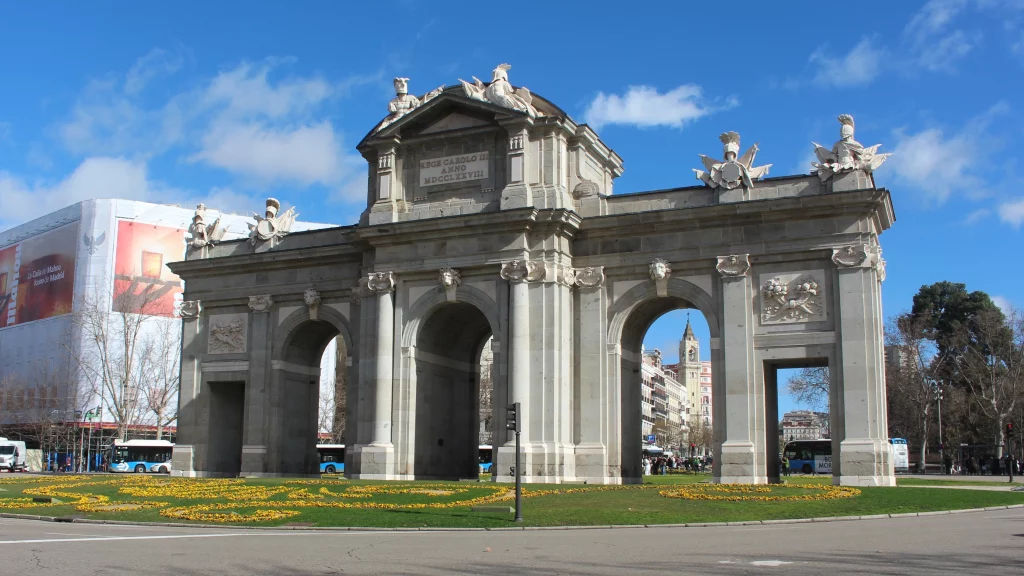
The last market I visited in Madrid was in the Salamanca district. I walked here from the Puerta de Alcalá, Madrid’s version of the Arc de triomphe. In itself this is worth going to look at, but it is unfortunately placed in the middle of a very busy roundabout so you can’t get up close, and photographs involve a careful timing between traffic lights.
Walking to the Mercado de la Paz, along the Calle de Serrano, took around 15 minutes, and you get an immediate feel as to what sort of market this is going to be. Just after the Puerta de Alcalá you get into an area filled with embassies and high-end boutiques. Prada and Versace shops are a fair sign of a high class neighbourhood making me believe this market would also be aiming at a different type of customer. I was not disappointed.
At the entrance to the market is a wine merchant, Vinoteca Tierra. If you are looking for some decent Spanish wine this would be a great place to start. They also sell wine by the glass.
The first stall inside was selling upscale sandwiches and snacks, further in are stalls selling foie gras, caviar and other luxury delights. The cheese stalls and olive stalls were a dream. I bought some little cakes to take home from a stand selling Spanish delicacies and nougat.
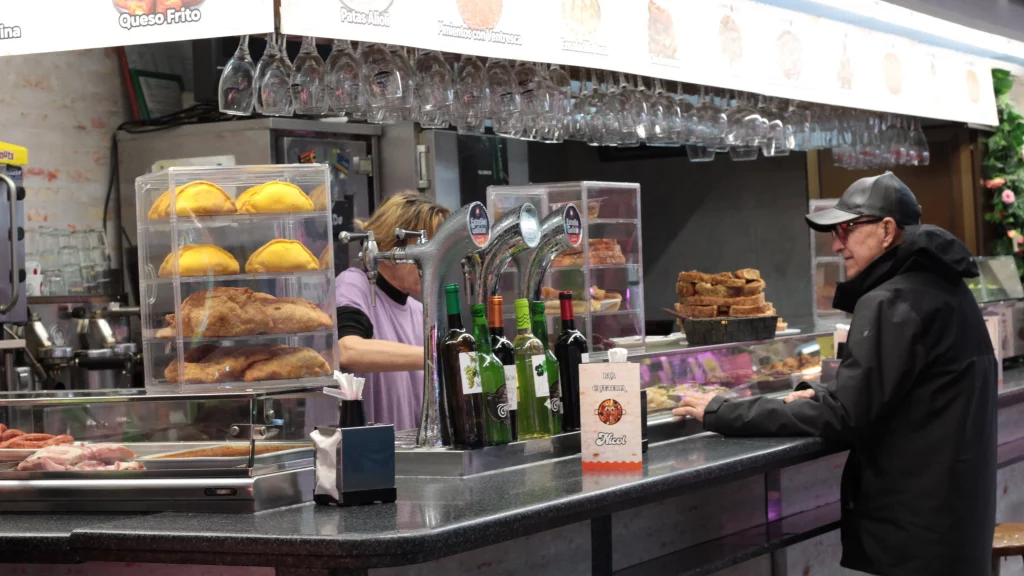
Perhaps half of this market is taken up with food stands. And while some of them are the counter and bar stool type, far more resembled restaurants. Some had queues to be seated. Of all the markets I visited this was probably the one that tourists would be the least conspicuous, or most welcomed. Some of the produce was clearly aimed at tourists, but in a traditional rather than tacky way.
If you are not tempted by the food stalls in the market (or if they are too busy) you could try the tapas bar Jurucha opposite the market (but when I visited this was busier than the market) or the Carmen bar around the corner, where I had a very nice shrimp and avocado taco.
Is there a real alternative to Mercado de San Miguel
If you are looking for a real alternative to the Mercado de San Miguel I honestly don’t think you will find it, at least I haven’t. Not because some of the other markets aren’t worth visiting, they are. But they are not centred around the tourist in the way that the Mercado de San Miguel is. The Mercado de San Miguel is also a beautiful, heritage, building that none of the markets I visited could compete with.
However, I do think some of the markets are worth seeking out, depending on what you are looking for.
If you are looking for an authentic market with fresh produce then visit the Mercado Maravillas.
If you are looking for a market to taste some tapas and a little bit of local life then visit the Mercado de Anton Martin.
If you are looking for a gastronomic high class market then visit the Mercado de la Paz.
Let me know in the comments if you have visited any other markets in Madrid and what you thought of them.
If you are planning your first trip to Europe then make sure your read How to plan a trip to Europe: the 3 essential first steps

If you need help with planning your trip then check out our services

If you have any questions about travel itineraries in Europe then drop us a line.  We are happy to help.

If you want more tips and ideas for visiting Europe then FOLLOW ME ON INSTAGRAM